









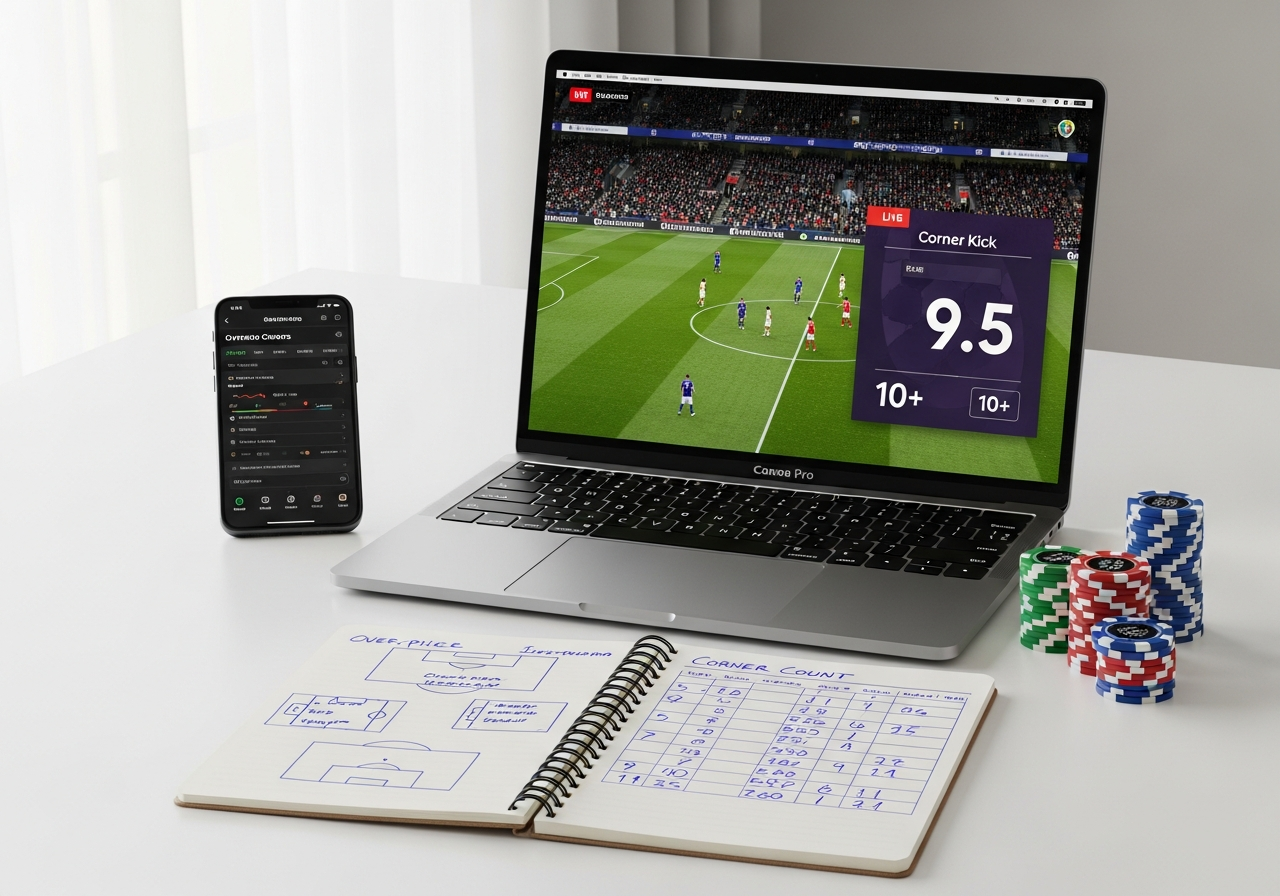
Total corners betting offers Indian football fans a refreshing alternative to traditional match result predictions. Whether you follow the Indian Super League (ISL), the I-League, or popular broadcast leagues like the English Premier League, corners present a market that rewards careful observation and data-driven analysis. Unlike predicting outright winners, corners betting focuses on a specific, measurable event that occurs throughout every match—making it ideal for fans who want to leverage their understanding of team tactics, playing styles, and match dynamics without relying solely on luck.
The appeal for Indian punters is straightforward: corners happen frequently, they’re directly observable on screen, and they correlate predictably with attacking intent, defensive pressure, and overall match tempo. If you’ve spent years watching ISL matches or European football on streaming platforms, you already have the foundation to succeed in corners markets. This guide transforms that intuitive understanding into a structured, stats-driven framework you can apply match after match.
Understanding Total Corners Markets As An Indian Bettor
Total corners betting allows you to wager on the aggregate number of corners awarded during a match, rather than on the match result itself. When you see an over/under line of 9.5 corners, you’re being offered the chance to predict whether the actual corner count will exceed 9 or fall at 9 or below. This straightforward structure underpins most corner markets you’ll encounter with Indian bookmakers, though variations exist across different bet types.
The reason corners markets appeal to both casual and serious bettors is that they’re often easier for bookmakers to misprice than match outcomes. While the winner of a football match depends on countless variables—luck, refereeing decisions, individual skill moments—corners follow more predictable patterns based on team tactics, possession rates, and attacking style. A team that consistently plays wide crosses, maintains high possession, and faces defensive blocks will earn corners at a measurable rate. Bookmakers, focusing heavily on match odds, sometimes set corner lines with less precision, creating opportunities for disciplined analysis.
Key Corner Bet Types You’ll See With Indian Bookmakers
- Match Total Corners (Over/Under): Bet on whether the total corners in a match will be above or below a fixed line (e.g., over 9.5, under 10.5). This is the most common market and offers straight-win or straight-loss outcomes.
- Asian Total Corners: Split bets where your stake is divided between two lines (e.g., 9/9.5). If the match hits exactly the lower line, you win half your stake on one side and push (neither win nor lose) on the other, reducing variance.
- Team Total Corners: Bet specifically on how many corners one team will earn. Useful for analyzing which side is likely to be under sustained pressure or attacking more actively.
- First-Half Corners: Restrict your wager to corners awarded only in the first 45 minutes, often lower in number and revealing of early match tempo and intensity.
- Both Teams 3+ Corners: A popular parlay-friendly market where you predict each side will earn at least 3 corners, typically occurring in open, attacking matches.
- Race to Corners: Wager on which team will reach a specific corner milestone first, combining speed and attacking intent into a single prediction.
How Total Corners Bets Are Calculated And Settled
Only awarded corners count toward your settlement. A corner is awarded when the ball crosses the goal line after last being touched by a defensive player; it does not matter whether the resulting delivery reaches a teammate or leads to a shot. Disallowed corners, or situations where the referee reverses a corner decision before it’s taken, do not count. Most bookmakers exclude extra time (penalty shootouts) from corner totals unless explicitly stated in their terms, so always verify your local bookmaker’s settlement rules before placing a bet.
For Asian total corners, if the match total lands exactly on one of your split lines, that portion of your stake will push (be returned in full), while the other portion settles normally. This push mechanism is why Asian lines appeal to risk-averse bettors: you’re effectively halving variance at the cost of slightly lower odds. Check your bookmaker’s terms and conditions, as settlement rules can vary slightly between operators in India and internationally.
Core Data And Stats That Drive Winning Corners Bets
| Stat / Factor | Why It Matters For Corners | Practical Example (ISL / Top European League) |
|---|---|---|
| Average Corners Per Match | Establishes a baseline; teams with 5.5+ avg corners tend to play wider or face more pressure. | An ISL team averaging 6 corners when attacking or 4 when defending provides context for opponent matchups. |
| Crosses Per Game | Direct indicator of wing play and attacking intent; higher crosses often precede defensive blocks and corners. | A team attempting 20+ crosses per match is likely to generate 1–2 extra corners against compact defenses. |
| Shots From Wide Areas | Reveals sustained pressure down the flanks; wide shots often lead to corners when blocked. | An EPL side with 8+ wide attempts signals a corner-heavy match if the opponent sits narrow. |
| Possession & Tempo | High possession doesn’t guarantee corners, but sustained pressure (>60% possession + aggressive pushing) correlates with more set pieces. | ISL teams pressing high and keeping the ball tend to earn 1–2 additional corners against sides that clear often. |
| Defensive Clearances | Teams clearing frequently from the flanks indicate they’re under lateral pressure and likely giving up corners. | An opponent with 15+ clearances per match signals defensive vulnerability to wide attacks. |
| Set-Piece Reliance | Teams with limited open-play goals often rely on set pieces, indicating they’ll earn and utilize corners heavily. | I-League sides playing more direct football generate higher corner counts but also concede more when pressed. |
The key shift in advanced corners analysis is moving beyond raw averages to predictive drivers. A team’s average corner total is useful as a starting point, but the reason it achieves that average—whether through wing dominance, possession pressure, or defensive frailty—tells you whether the average will hold or shift in a specific matchup. A team averaging 5 corners might jump to 7 against a high-pressing opponent and drop to 3 against a low block. Understanding the mechanism behind the number is what separates consistent corners bettors from casual speculators.
Building A Simple Corners Data Routine For Indian Fans
- Select one league to start: Choose either the ISL, I-League, or a major European league you watch regularly (EPL, La Liga, or Serie A). Consistency within one league helps you spot team tendencies and bookmaker line bias more quickly.
- Pick 5–10 teams and track 5–10 recent matches per team: Record the exact corner total, crosses attempted, wide shots, and possession percentage for each match. A simple spreadsheet or notebook works perfectly.
- Note supporting context: Record whether each team won, lost, or drew; the opponent’s style (high-pressing, low block, counter); and any tactical notes (heavy wing play, direct football, etc.).
- Identify repeatable high and low patterns: After 40–50 match observations per team, you’ll notice which matchup styles consistently produce 10+ corners, which produce 6–8, and which stay below 6.
- Compare your observations to bookmaker lines: Track how often the bookmaker’s 9.5 or 10.5 line aligns with your projected range. Over time, you’ll develop a feel for when the market is over- or under-pricing.
- Review and refine monthly: Revisit your data to spot changes in team tactics, injuries, or managerial shifts that might alter corner profiles.
This routine takes roughly 15–20 minutes per matchday but builds a personal database that no generic predictor can replicate for your specific viewing patterns and leagues.
Pre-Match Total Corners Strategy: From Stats To Selections
- Shortlist fixtures based on matchup style: Ignore matches where the corner potential is ambiguous (e.g., one team’s style is unknown, very recent team changes). Focus on fixtures where both teams have clear, established playing profiles—wing-heavy vs. compact, possession-dominant vs. counter, etc.
- Project a corners range using your data: Using your recorded metrics (average corners, crosses, possession tendencies), estimate a likely range. If Team A averages 5.5 corners and Team B averages 4 corners when defending, project 9–11 total corners for their matchup.
- Compare your projection to the bookmaker’s line: If your range is 9–11 and the market offers 9.5 over/under at similar odds, you have no edge—skip it. If the market shows 8.5 or 11.5 and your range is 9–11, there’s a value opportunity.
- Check matchup-specific context: Review head-to-head history (if available), recent form, injuries to key attacking or defensive players, and any derby intensity that might elevate aggression and set-piece volume.
- Assess weather and pitch conditions: Monsoon rains or waterlogged pitches common during Indian football seasons can alter clearance patterns and increase desperate defensive headers, sometimes boosting corner counts. Poor conditions can also reduce precision and increase blocks.
- Review referee tendencies if known: Some referees award corners more generously in attacking zones; if information is available, factor it in, though this level of detail is often unavailable for ISL or I-League matches.
- Decide bet or skip: Place a bet only if you have clear positive expected value (your projection supports an over or under bet against the market line). Otherwise, skip and wait for the next opportunity.
Using Team Styles And Tactical Matchups To Predict Corners
Attacking wing play is perhaps the strongest corner predictor. Teams that consistently target wide midfielders, fullbacks in advanced positions, and direct crosses to the flanks generate corners at higher rates because wings are where defensive blocks most often occur. A team playing with two attacking fullbacks or wide forwards will earn corners naturally from their own attacks; they’ll also likely concede corners if the opponent similarly attacks the wings.
Set-piece reliance is a tactical fingerprint. Some teams, particularly in lower-tier Indian leagues, play more directly and depend on set pieces for goals because they lack dynamic open-play attacking options. These teams both earn and concede more corners. Conversely, possession-dominant sides that play through the middle can have lower corner counts despite high possession.
Pressing intensity also matters. A team pressing high up the field forces the opponent to clear longer and further, often resulting in corners when clearances go out of bounds. A low-block defense invites pressure, which translates to more corner opportunities for the attacking team but fewer for the defending side. When you see two high-pressing sides face each other—common in aggressive ISL derbies—corner counts tend to spike.
Adjusting For Match Context, Weather And Referees
Derby matches and must-win situations often see increased intensity and wider, more direct play, pushing corner totals higher. A team needing a win might abandon their usual passing style and resort to throwing in crosses, lifting corner counts by 1–2 above their average.
Monsoon seasons in India present unique conditions. Heavy rain, waterlogged pitches, and poor field conditions force defenders to clear more aggressively and less precisely. Corners can increase simply because the ball spends more time in the air and bouncing unpredictably off wet turf. However, extremely poor conditions might also reduce overall play tempo, offsetting the gains. Monitor weather closely and be willing to shift your projection by 0.5–1 corner if conditions are notably adverse.
Referee tendencies are harder to quantify for Indian leagues due to less centralized data, but in European broadcasts, you might research whether a particular official is known for awarding corners generously in the box. In the absence of clear information, stick to your technical projections rather than speculating on individual referee bias.
Asian Total Corners And Safer Lines: Risk Management For Indians
| Market Type | Risk Profile | Outcome Examples | Best Use Case |
|---|---|---|---|
| Fixed Over/Under (e.g., 9.5) | High variance; win or lose starkly. | If the match has 9 corners, you lose the whole stake on over 9.5. | Use when your projection is confident and the odds are attractive enough to justify the binary outcome. |
| Asian Total – Split Bet (e.g., 9/9.5) | Lower variance; half your stake at each line, allowing pushes. | If the match has exactly 9 corners, you win half the stake on under 9 and push on under 9.5. | Ideal for smaller bank sizes or uncertain projections; reduces variance at the cost of slightly lower payout. |
| Asian Total – Single Line (e.g., 9.5 split) | Moderate variance; smaller stakes on each side. | Your bet is split 50/50 between under 9 and under 9.5, each with proportional odds. | Best when you’re very close to a key number and want exposure to both outcomes. |
| Team Total Corners (Over/Under) | Varies; depends on team consistency. | Team A over 4.5 corners vs. Team B over 3.5 corners lets you isolate attacking potential. | Use when one team’s corner profile is clear (high-pressing, wing-dominant) and the opponent’s style is uncertain. |
Fixed over/under lines are simplest but demand conviction. If your analysis strongly suggests 10–11 corners and the bookmaker offers under 9.5 at reasonable odds, a fixed under-bet is appropriate. However, if your projection is 9–11 (uncertain between 9 and 10), the fixed 9.5 line offers minimal edge. This is where Asian totals shine for Indian bettors with modest bank sizes.
Setting Conservative Corner Lines And Margins Of Safety
- Apply a one-line buffer below your over projection: If your analysis projects 10–11 corners, consider betting over 9.5 rather than over 10.5. This buffer absorbs variance and unexpected match scripts while maintaining positive expected value.
- Prefer Asian totals near key thresholds: When your projection straddles a key market line (e.g., 9.5), use an Asian split at 9/9.5 instead of risking the full stake on a fixed line.
- Avoid extreme projections in slow-tempo matches: If the matchup features two defensive, low-tempo teams, do not bet over high corner lines (11+) simply because your model’s average suggests it. Tempo is paramount; defensive matches stay low regardless of team averages.
- Never chase losses by increasing stakes or bet size: If you lose a bet, your next bet should follow your standard unit sizing and only be placed if the matchup meets your selection criteria—not to recover the loss.
These conservative approaches won’t maximize short-term returns, but they’re designed for long-term sustainable edges and account for the variance inherent in corners betting.
Live Total Corners Betting: Exploiting Match Momentum
Live corners betting offers a distinct advantage: you can observe the actual match rhythm, intensity, and attacking patterns before committing your stake. Pre-match analysis is educated guessing based on data; live betting is reaction to observed reality. If a team is hammering the opponent’s flanks, forcing repeated blocks and corner kicks, you can place an over corners bet at reduced (and often more accurate) lines compared to the pre-match market.
Watch for live indicators that signal a corner surge. Repeated blocked wide shots suggest defenders are under lateral pressure; increased crosses mean the attacking team has shifted to wing play; one team visibly chasing a goal often resorts to direct, wide deliveries. Tactical substitutions—bringing on a winger or fullback—signal a shift toward corner-generating play. Fouls in advanced areas and aggressive pressing concentrate play in zones where corners result.
Live betting is particularly valuable in the later stages of matches when teams are desperate for goals. A team down 1–0 in the 70th minute will attack more aggressively, widening their play and generating corners at higher rates than suggested by the pre-match market.
Late-Game Over Corners Strategy (70th–85th Minute)
- Monitor the match score and possession at the 70-minute mark: If one team is trailing and increasing attacking pressure, note the current corner count and remaining match time.
- Assess available corner total for the match: If the match has accumulated 7 corners through 70 minutes and is on pace for 9–10 total, check the live over/under line (often offered at 8.5, 9, or 9.5 by that stage).
- Look for tactical shifts toward wing play: The trailing team brings on attacking players, and their crosses increase. The defending team, sensing pressure, clears more frequently to the wings.
- Compare the live line to your adjusted projection: If your original pre-match projection was 10–11 corners and the match is currently at 7 with 15+ minutes remaining, over 8.5 or 9 offers strong value, especially if you observe active wing play.
- Place a smaller live bet than your pre-match units: Live bets carry higher uncertainty (fewer minutes remain, more likely to win at a reduced line); keep stakes modest to reflect this risk.
- Avoid betting live over after the 80th-minute mark unless corner volume is extreme: With very few minutes left, even high-octane pressure is unlikely to generate 2+ additional corners, so late-stage overs are often poor value.
Reading Game State For Indian Leagues And Top European Matches
Translating what you observe on screen into corner signals is skill developed through consistent viewing. In ISL matches broadcast on television or streaming platforms, watch for sustained pressure phases: one team keeping the ball in the opponent’s half, forcing repeated defensive clearances, and executing crosses. Each cycle of pressure often yields one or more corners. Note how different referees and match conditions affect clearance decisions—some referees award corners more generously for marginal deflections.
In European leagues, the pace is faster and pressing higher, so corner-generating sequences happen quicker. A sustained spell of pressure can yield 2–3 corners in 3–5 minutes. In I-League or lower-tier ISL matches, corner-generating sequences are often slower; pressure builds more gradually, allowing you time to identify the pattern and place a live bet with confidence.
Combining Corner Markets: Building Robust Betting Setups
| Corner Market Combo | Pros | Cons | Ideal Match Profile |
|---|---|---|---|
| Match Over + Team Over (Same Team) | Targets aggressive matchups; if the match generates 11 corners and Team A dominates, both bets win. | Correlated legs; both bets fail if the match is defensive or competitive. | High-pressing team vs. low-block opponent; one team expected to dominate possession and attacking. |
| Match Over + First-Half Over | Two data points on match tempo; first-half over suggests sustained intensity. | Correlated; both likely hit or miss together; modest odds boost. | Fast-paced, attacking matchups (e.g., derby or must-win ISL games). |
| Both Teams 3+ Corners | Balanced exposure; doesn’t rely on one outcome; often good odds for open, competitive matches. | If one team is dominant, the other may struggle to earn 3 corners, losing the bet. | Balanced attacking profiles; two teams with similar corner-earning capacity. |
| Match Over + Asian Under (Different Lines) | Hedges variance; if the match is around your projected line (e.g., 9–10 corners), both bets could partly win or push. | Complex stake division; needs careful calculation; lower combined odds. | Uncertain projection around a key market line (9.5); want exposure without total loss risk. |
| First-Half Over + Late-Game Over | Captures both early intensity and late-game desperation; diversifies match phases. | First-half over signals high-tempo, but teams might sit defensively in the second half, losing late-game over. | Aggressive, high-intensity matchups with clear favorites (likely to chase late if trailing). |
From Single Bets To Small Corner Multiples And Trebles
Building multiples (parlays) on corner markets is tempting because odds multiply, but correlation is a major risk. If your three corner selections are all exposed to the same match (e.g., Match A over 9.5 + Match A first-half over 4 + Match B over 8.5), a single defensive half in Match A can wipe out two of your three bets.
Safer multiples reduce correlation: combine first-half over in Match A with full-match over in Match B (different matches), or use conservative lines one step below your strongest projection on each leg. Keep multiples to two or three legs maximum; each additional leg compounds variance. Stake multiples at 25–50% of your single-bet unit size, reflecting the higher risk of correlated failure.
Example: If your standard single-bet unit is 100 rupees on one match, a three-leg corner multiple might be 50 rupees total, split across three different matches with confidence-ranked legs. This approach gives you upside (higher payout) while managing the downside (fewer unit losses if one leg fails).
League-Specific Angles For Indian Football Fans
- Indian Super League (ISL): Tends toward wing-heavy, high-tempo attacking play with decent defensive intensity. Average corner totals typically range from 9–11 per match. Teams often prefer crosses over intricate passing, making corners predictable. Derby matches frequently exceed 12 corners due to intensity.
- I-League: Generally lower tempo and more compact defending than ISL. Average corner totals are often 7–9 per match. Teams rely more on direct play and set pieces, meaning corner variance is higher (some matches stay at 5, others spike to 12) depending on matchup.
- English Premier League (EPL) / Top European Leagues: Fastest-paced, highest-press leagues. Average 10–12 corners per match with tight variance. Wing play is premium; attacking fullbacks generate corners naturally. Data is abundant, making mispricing rare.
- La Liga (Spain): Possession-dominant, lower direct play. Average 8–10 corners; variance is lower because play is more controlled. Corner lines are often set very efficiently due to heavy European betting.
- Serie A (Italy): Defensive, set-piece-heavy. Average 8–10 corners but with higher variance (some defensive matches hit 5, others with aggressive sides hit 13). Referee tendencies matter more; some Serie A officials award corners generously.
Each league has its own corner profile, and successful Indian bettors should practice within one league before attempting to diversify. ISL and EPL are most accessible for Indian fans and offer the best data availability.
Focusing On High-Corner Teams And Matchups
| League / Team Profile | Corner Tendencies | Strategic Implication For Bets |
|---|---|---|
| Cross-Heavy Attacking Teams | Generate 5.5–7 corners per match regardless of opponent; consistently high volume. | Back over matches when these teams play; their style forces corners even against compact defenses. |
| Possession-Dominant Teams (55%+ avg) | 5–6 corners per match; sustained pressure but controlled play limits corner spikes. | Over-corner bets require strong edge only if opponent is very defensive; otherwise, limited variance makes betting risky. |
| Counter-Attacking, Direct Teams | 3–5 corners per match when attacking; high variance depending on opposition pressure. | Avoid corner overs against defensive opponents; bet unders or skip. Only back overs if matched against high-pressing sides that leave space for counter chances. |
| Low-Block Defensive Teams | Concede 5–6.5 corners per match; allow opponent crosses but rarely generate their own. | When these teams face cross-heavy opponents, expect 11+ total corners; strong over signal. When facing counter-attackers, expect 8–9 total corners. |
| High-Pressing, Aggressive Teams | Generate 6–7 corners + concede 4–5; extreme variance (8–14 total) based on opponent style. | Avoid betting aggressively; high variance makes predicting direction difficult. Use only when matched against equally aggressive teams (corner spike) or very defensive opponents (clear unders). |
Avoiding Low-Value Corner Spots
Skip matches where teams are mismatched in skill or motivation but corner patterns are unclear due to small sample size. If Team A has only three recent matches on record, your corner projections will be unreliable. Wait for larger samples (5+ matches) before betting confidently.
Dead rubber matches—games where both teams have already secured or been eliminated from qualification—see reduced effort and corner volume. Avoid these entirely, even if market lines appear loose.
Extremely poor pitch or weather conditions in Indian leagues (peak monsoon, waterlogged fields) can make corner prediction erratic. If match reports suggest the field is unplayable, skip and wait for normal conditions.
Strong mismatches between your corner projection and market expectations (e.g., you project 9–10 but the market is at 11.5 with tight odds) signal that the market has spotted something you haven’t. Consider it a skip unless you have strong conviction otherwise.
Practical Corner Betting Framework For Indian Punters
- Pre-Match Checklist (Day Before Match): Review both teams’ recent corner counts (5+ matches), note crosses per game, assess upcoming opponent’s defensive style, check for injuries to key attacking/defensive players, and review weather/pitch reports. Generate a corner range projection.
- Market Comparison (Match Day Morning): Compare your projected range to the bookmaker’s offered lines. Identify if there’s clear edge (your 10–11 projection vs. market 8.5 or 11.5).
- Bet/Skip Decision: Place a bet only if your edge is clear (typically ±1 corner minimum) and the odds justify the variance. Skip if the line aligns with your projection.
- Stake Sizing: Use standard units (1–2% of bankroll per bet) for confident selections. Reduce unit size for live bets, league adjustments, or multiples.
- Match Observation (Live): Watch for divergence between your pre-match projection and actual match tempo. If the match is visibly more defensive or offensive than expected, note it for post-match review.
- Post-Match Review: Record the actual corner total, note whether your projection was accurate, and identify what changed (tactical shift, unexpected injuries, referee style, weather impact). Over time, these notes refine future projections.
Example Walkthrough: From Data To Bet On One Match
Imagine you’ve been tracking two ISL teams: Team A (wing-heavy attacker, averaging 6 corners) and Team B (compact defender, allowing 4.5 corners per match). Team A is playing at home against Team B. Your data shows Team A’s home matches average 0.5 more corners, and Team B concedes 0.5 fewer corners away; your adjusted projection is 9–11 total corners (6.5 Team A + 4 Team B).
The bookmaker offers over/under 9.5. Your projection’s lower bound is 9, so backing over 9.5 has modest edge. However, you check the head-to-head record: the last three meetings averaged 10.75 corners, and weather is clear (no monsoon impact). You slightly increase confidence to 10–11 total. Over 9.5 now feels like a solid +EV bet. You place a standard unit at over 9.5. The match ends with 11 corners; you win.
Now imagine an alternative scenario: the bookmaker offers over/under 10.5. Your projection is 9–11, centered at 10. Over 10.5 has minimal edge (your median is exactly at their line). You skip and wait for the next fixture. This discipline avoids low-probability bets and preserves bankroll for higher-confidence opportunities.
Tools, Apps And Data Sources Useful For Corner Analysis
| Tool Type | What It Provides | How Indian Bettors Can Use It |
|---|---|---|
| Live Score Apps (ESPN, FlashScore, OneFootball) | Match stats (corners, crosses, shots), live line movements, team lineups. | Verify corner counts post-match; track historical stats; observe live market movements during matches. |
| Advanced Stats Sites (Understat, Opta, WhoScored) | Possession, passes, shots, crosses, expected goals (xG), defensive actions. | Extract corner drivers (crosses, wide shots, possession); compare team profiles across leagues. |
| Prediction/AI Models (various public sites) | Predicted corner totals, match predictions, league standings. | Use as a starting point or sanity check, but do not rely solely; build your own projections. |
| Betting Odds Aggregators | Compare bookmaker lines across multiple sites. | Identify soft lines (mispriced overs/unders) by comparing consensus vs. outlier odds. |
| YouTube Highlights / Match Clips | Visual confirmation of team tactics, attack patterns, defensive shape. | Watch 5-minute highlight reels to confirm wing play, crossing frequency, and pressing intensity before placing large bets. |
Public prediction models are tools, not gospel. A model predicting 10.2 corners gives you a reference point, but your own observations and data collection are ultimately more reliable. Bookmakers also feed AI models, so published predictions sometimes lag market lines.
Building Your Own Simple Corners Dashboard
- Spreadsheet Setup: Create columns for match date, team names, corner total, crosses, wide shots, possession %, and outcome (win/draw/loss). Add a notes column for tactical observations (wing-heavy, set-piece reliant, etc.).
- Data Entry Post-Match: Spend 2–3 minutes per match entering data from live score apps or official league websites. This habit builds your personal database quickly.
- Monthly Review: Sort data by team, opponent, home/away, and league. Identify repeating patterns (e.g., “Team A vs. compact defenses always hits 11+”, “Team B’s away corners drop 1–2 below home baseline”).
- Refine Projections: Use your dashboard to adjust future projections. If your historical data shows Team A averages 6.2 corners at home but you earlier assumed 6, update your model.
A well-maintained dashboard becomes invaluable. After three months of one league, you’ll have 30+ team-match observations, enough to spot reliable patterns and exploit bookmaker lines with confidence.
Common Mistakes And Mindset For Long-Term Corners Success
Many Indian bettors fail at corners betting by relying only on average corners without analyzing the matchup context. A team averaging 5 corners is not a predictable 5-corner team; it’s a team that averages 5 when facing a median defensive opponent. Against a high-press attacker, that average climbs; against a low block, it falls. Ignoring matchup context is the quickest path to consistent losses.
Chasing losses is another universal pitfall. A losing bet doesn’t signal that your next bet should be larger or that you should bet every match to “get even.” Corners betting requires patience and selectivity. Some weeks you’ll spot three high-conviction bets; other weeks, zero. That’s normal variance, not a signal to lower standards.
Overusing high-risk accumulators (parlays on many legs) concentrates variance and often leads to lopsided records (many losses, few big wins). The long-term edge in corners is modest (2–5% per bet), meaning accumulators compress that edge and increase the likelihood of short-term ruin.
Betting every match is a trap. If only two of your carefully observed fixtures offer clear edge that day, bet those two and skip the rest. Discipline in bet selection is more valuable than activity.
Treat corners as a data process, not a gut-feel market. Document your projections, compare them to results, and refine your model. Accept that variance will produce losing streaks; a 55% win rate (55 wins, 45 losses per 100 bets) is excellent in corners and will feel painful during cold spells. Review decisions to improve, but remain committed to your process.
Avoiding Overconfidence And Short Samples In Corners Betting
- Do not generalize from 2–3 matches: If Team A beats Team B 3–0 in one match with 8 corners, that one result doesn’t define the pairing. You need 5+ head-to-head matches or 10+ comparable matchups to spot a reliable pattern.
- Watch for hot-streak bias: If your corner predictions hit three times in a row, you haven’t become a genius; you’ve simply experienced normal variance in your favor. Maintain discipline and avoid increasing bet sizes or lowering edge thresholds.
- Keep expectations realistic: A well-executed corners strategy yields 52–56% win rates over long samples. Expect losing months; they’re statistically normal and don’t signal failure if your process is sound.
- Maintain selectivity as you grow confidence: As your database expands, you can afford to place more bets per matchday, but only if each meets your edge threshold. Expanding volume without maintaining edge is a recipe for slow decline.
- Stay humble about league shifts and tactical evolution: A team’s corner profile can shift if they hire a new coach, sell a key player, or face injury to an attacking leader. Monitor for these changes and update your projections; past performance is not guaranteed to repeat.
Long-term success in corners betting emerges from treating it as a craft—combining publicly available data, personal observation, careful record-keeping, and disciplined decision-making. The edge is real but modest, the variance is real but manageable, and the opportunity is available to any Indian bettor willing to invest the time and rigor to develop it.