









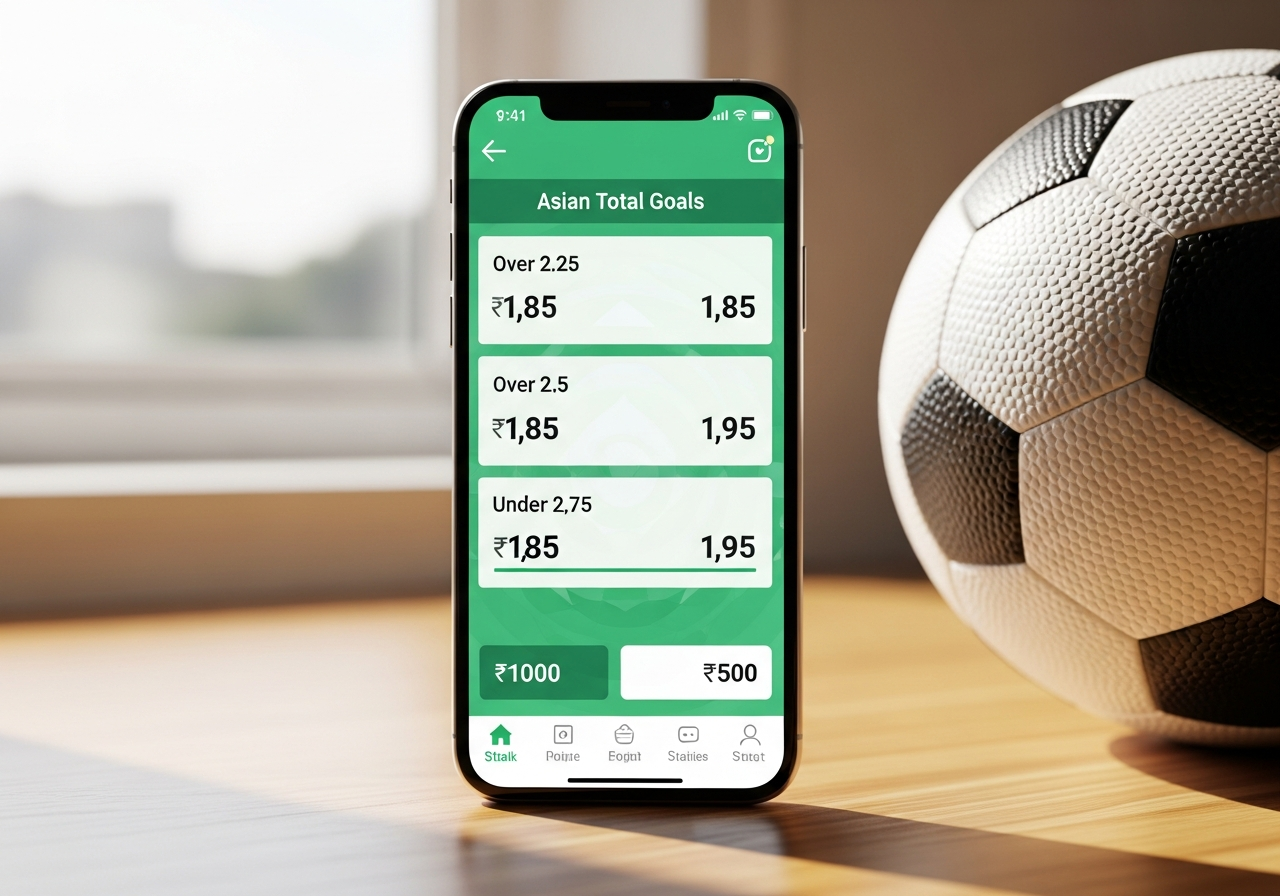
If you’ve been betting on football through Indian betting platforms, you’ve likely come across the familiar Over/Under 2.5 Goals market. It’s straightforward: the bookmaker sets a line, you predict whether the total goals will be over or under that number, and you win or lose based on the final result. But what if there’s a smarter way to manage your risk while gaining finer control over your goal predictions? That’s where Asian Total Goals come in, and they’re becoming increasingly popular on top Indian betting sites, especially for Premier League matches and major international tournaments.
Unlike the rigid structure of classic over/under betting, Asian Total Goals introduce multiple line types and flexible settlement options that can soften losses and create partial refunds. For Indian punters, this means better bankroll protection, reduced emotional swings during losing streaks, and the ability to fine-tune predictions around critical goal thresholds. Best of all, these markets are now widely available on India-facing betting apps with full rupee and UPI support, making them accessible and practical for everyday bettors.
Understanding Total Goals and Asian Totals
In football betting, total goals markets operate independently of the match outcome—it doesn’t matter who wins or loses; you’re only predicting the combined goals scored by both teams. A bookmaker sets a line (such as 2.5 or 3.5 goals), and bettors choose whether the final tally will be over or under. With classic over/under betting, this is binary: you either win or lose, and if the match lands exactly on the line (a rare scenario for half-goal lines), settlement depends on the specific market rules.
Asian Total Goals use the same underlying concept—predicting total goals—but introduce different types of lines (whole numbers, half numbers, and quarter increments) that create more nuanced outcomes. Instead of a simple win/lose result, Asian totals can deliver pushes (stake refund), half wins, and half losses. This flexibility stems from Asian handicap logic, which was originally developed to eliminate the possibility of a draw in spread betting. Applied to goals, these principles allow bookmakers to offer multiple price points and give bettors control over their risk exposure.
Classic Over/Under Goals Basics for Indian Bettors
Traditional over/under goals betting is the foundation upon which Asian totals are built. Here are the key features Indian bettors should understand:
- Fixed line at half-goal increments: Bookmakers typically set lines at 0.5, 1.5, 2.5, 3.5, and higher (e.g., Over 2.5 means 3 or more goals to win, Under 2.5 means 0–2 goals to win).
- Two outcomes only: You win the full bet or lose the full stake; there’s no middle ground.
- No refund on exact line: If a market uses a whole number like Over 2.0, and the match ends with exactly 2 goals, the bet is a push (stake returned) rather than a win.
- Simple odds structure: Classic over/under typically offers one set of odds per match, making comparison straightforward.
- Relevant across all Indian betting platforms: Nearly every sportsbook offers this market with clear rupee pricing and instant settlement.
What Makes Asian Total Goals Different
Asian Total Goals expand the range of available lines and introduce flexibility in how stakes settle. Rather than choosing between a single Over 2.5 or Under 2.5, an Indian bettor can select from whole lines (2.0, 3.0), half lines (2.5, 3.5), and quarter lines (2.25, 2.75). This variety allows stake returns when a match lands on a whole-number line, and partial refunds when results trigger half-win or half-loss outcomes on quarter lines.
For Indian football fans, the appeal is clear: these markets reduce the sting of marginal losses. If you bet Over 2.5 and the match ends 2–0, you’ve lost your entire stake. But if you’d placed the same bet on Over 2.25, half of your stake would be refunded. Over time, in volatile leagues like the Premier League or Indian Super League, these partial refunds can meaningfully improve your long-term results. Additionally, because Asian totals offer multiple price points, you may find better odds on a quarter line than on the classic over/under, rewarding careful line selection.
Types of Asian Total Goal Lines
Asian total goal lines come in three main varieties, each with distinct settlement mechanics. Understanding their differences is crucial for selecting the right market for your prediction and bankroll strategy.
| Line type | Example | Stake behaviour | Possible outcomes |
|---|---|---|---|
| Whole (Full) | 2.0, 3.0, 4.0 | Stake refunded if goals equal the line | Win, Lose, Push (void) |
| Half | 2.5, 3.5, 4.5 | Stake won/lost based on over or under | Win, Lose (no push possible) |
| Quarter | 2.25, 2.75, 3.25 | Stake split into two equal parts | Full Win, Full Loss, Half Win, Half Loss |
Whole lines (2.0, 3.0) are settled with a push if the match total exactly equals the line—your stake is returned with no profit or loss, just like a draw in match betting. Half lines (2.5, 3.5) never result in a push because a match cannot end with a half goal; they always produce a win or loss. Quarter lines (2.25, 2.75) are the most complex, as they split your stake across two adjacent lines, creating four possible outcomes. On Indian betting sites, whole-line pushes appear in your bet history as “Settled as Void” or “Stake Returned,” instantly credited back to your account balance in rupees.
Whole, Half and Quarter Lines Explained
Whole lines represent complete goal totals: 2.0, 3.0, 4.0, etc. When you bet on Over 2.0, you win if the match has 3 or more goals. When you bet on Under 2.0, you win if the match has 0 or 1 goal. If the match ends with exactly 2 goals, your stake is returned as a push. This push feature is attractive because it removes one losing outcome; your bankroll is protected in what would have been a losing scenario under classic over/under rules.
Half lines (2.5, 3.5, 4.5) work much like traditional over/under markets. A bet on Over 2.5 wins at 3+ goals and loses at 0–2 goals. There’s no push possible because a match can never total exactly 2.5 goals. Half lines are the most familiar to Indian bettors and offer straightforward settlement in real time.
Quarter lines (2.25, 2.75, 3.25, 3.75) are where Asian totals become genuinely different. Your stake is split equally between two adjacent lines—typically a whole line and a half line. For example, a ₹100 bet on Over 2.25 is split into ₹50 on Over 2.0 and ₹50 on Over 2.5. Each part settles independently, creating four possible outcomes: both halves win (full win), both halves lose (full loss), one half wins and one pushes (half win), or one half loses and one pushes (half loss). This mechanism gives quarter lines their risk-reducing appeal.
How Quarter-Goal Asian Totals Work
Quarter-goal lines are the most innovative and misunderstood aspect of Asian total goals. They’re worth diving into in detail because they can dramatically shift your expected value in tight matches and offer a practical edge for Indian punters who consistently face close scorelines.
When you place a quarter-goal bet, the bookmaker automatically splits your stake into two equal halves linked to the adjacent whole and half goal lines. Let’s say you place a ₹100 bet on Over 2.25 at odds of 1.85. The bookmaker internally splits this into:
- ₹50 on Over 2.0 (whole line)
- ₹50 on Over 2.5 (half line)
Each part is settled separately based on the final goal count. If the match ends with 3 goals, both parts win—you receive the full payout on your ₹100 stake. If it ends with 0 or 1 goal, both parts lose and you lose the entire stake. But if it ends with exactly 2 goals, Over 2.0 is a push (₹50 refunded) while Over 2.5 loses (₹50 lost), resulting in a half loss. And if it ends with 2 goals, Over 2.0 pushes and Over 2.5 loses, meaning you get ₹50 back and lose ₹50—a half loss of ₹50 net.
This flexibility is why quarter lines appeal to Indian bettors. In tight matches where you expect a low-scoring draw or a 2–1 result, a quarter line can cushion the blow.
Stake Splitting on 2.25 and 2.75 Lines
Understanding the step-by-step mechanics of stake splitting helps you predict outcomes and make confident betting decisions:
- Place your bet on a quarter-goal line (e.g., Over 2.25) and confirm your stake amount in rupees on your Indian betting app.
- The bookmaker automatically splits the stake into two equal parts: 50% on the adjacent whole line (Over 2.0) and 50% on the adjacent half line (Over 2.5). This happens instantly; you won’t see the split in your bet slip, but it’s how the market is calculated.
- Each part is settled independently based on the final goal count, following standard rules: the whole line can result in a win, loss, or push; the half line results in a win or loss.
- Combine the results of both parts to determine your overall outcome: both win = full win (entire stake paid), both lose = full loss (stake lost), one wins and one pushes = half win, or one loses and one pushes = half loss.
- Stake is returned or adjusted instantly in your account balance. On most India-facing sites, half losses show as “Partially Lost” or the net amount is calculated and displayed in your bet history.
Outcome Scenarios for Over 2.25 and Under 2.25
To cement your understanding, here’s how different final goal counts settle your Over 2.25 and Under 2.25 bets:
| Total goals | Over 2.25 result | Under 2.25 result | Stake effect |
|---|---|---|---|
| 0–1 goals | Full loss (both parts lose) | Full win (both parts win) | Entire stake lost or won |
| Exactly 2 goals | Half loss (Over 2.0 pushes, Over 2.5 loses) | Half win (Under 2.0 pushes, Under 2.5 wins) | Half stake refunded, half lost or won |
| 3+ goals | Full win (both parts win) | Full loss (both parts lose) | Entire stake won or lost |
This table demonstrates why quarter lines are particularly valuable in balanced fixtures. A 2–0 scoreline is common in football; with Over 2.5 you’d lose everything, but with Over 2.25 you’d recover half your stake.
Asian Total Goals vs Classic Over/Under
The core difference between Asian total goals and classic over/under betting lies in line flexibility, settlement outcomes, and the resulting impact on bankroll management. Let’s compare them side by side:
| Feature | Classic Over/Under | Asian Total Goals | Impact for Indian bettors |
|---|---|---|---|
| Line options | Single line per match (e.g., Over 2.5 or Under 2.5) | Multiple lines: whole (2.0), half (2.5), quarter (2.25) | Asian totals provide finer control over goal thresholds and risk appetite |
| Possible outcomes | Win or lose only | Win, lose, push (whole lines), or half win/half loss (quarter lines) | Asian totals reduce all-or-nothing losses via pushes and partial refunds |
| Settlement on exact line | Depends on market (some void at 2.5, some don’t) | Whole lines void (stake returned); half and quarter lines never settle exactly | Indian bettors get clearer expectations and less ambiguity |
| Typical odds | Fixed per market | Varies by line type (whole lines often lower odds, quarter lines mid-range) | Astute bettors can find better value on alternative lines |
| Bankroll protection | None; a loss is a full loss | Partial protection via half losses and pushes | Better long-term results in volatile leagues; reduced variance |
Risk and Reward Differences
Asian total goals are often perceived as lower-risk than classic over/under betting, and that perception is justified—but only conditionally. A quarter-line bet that results in a half loss is indeed less damaging than a full loss. Over a series of bets, these partial refunds smooth your bankroll curve and reduce the likelihood of catastrophic losing streaks.
However, lower risk doesn’t mean no risk, and it doesn’t guarantee profit. The odds on Asian totals are typically set to reflect their lower variance; you might receive 1.72 for Over 2.25 instead of 1.95 for Over 2.5, compensating the bookmaker for the extra risk of partial refunds. Indian punters should view Asian totals not as a magic solution but as a bankroll-management tool. Use them when you want to hedge your expectations around critical goal thresholds—especially in matches where you’re uncertain whether the total will be 2 or 3 goals. Use classic over/under when you have high confidence and want maximum payout on a binary prediction.
Full, Half and Quarter Outcomes in Asian Totals
Before placing an Asian total bet, you need to know exactly what each outcome means for your stake and bankroll. There are four possible results:
- Full win: Your entire stake is multiplied by the odds and you receive the full payout. This occurs when both parts of a quarter-line bet win, or when you bet on a half or whole line and the result favors you.
- Full loss: Your entire stake is lost with no refund. This happens when both parts of a quarter line lose, or when a half line settles against you.
- Half win: Half of your stake is returned plus half of your original stake is multiplied by the odds, resulting in a profit on exactly half your bet. This occurs on quarter lines when one part wins and one part pushes.
- Half loss: Half of your stake is returned and half is lost, resulting in a net loss of half your original stake. This occurs on quarter lines when one part loses and one part pushes (or in whole-line bets at the push line).
Additionally, push or void outcomes occur on whole-number lines (2.0, 3.0, 4.0). When the final goal count equals the line, your entire stake is refunded instantly with no profit or loss. On Indian betting sites, this appears in your history as “Settled as Void” or “Stake Returned,” and the rupee amount is credited back to your account immediately.
How Push and Stake Refund Work on Indian Betting Sites
When you place a bet on a whole-number Asian total line like Over 2.0 or Under 3.0, and the match ends with exactly that number of goals, your stake is pushed. On India-facing betting platforms, this is one of the cleanest settlement processes you’ll encounter. Your rupee stake is instantly credited back to your account balance—no waiting, no questions. You’ll see it marked as “Void” or “Push” in your bet history alongside the settled date and time, and in your account statement it simply shows a net zero result for that particular bet.
This is superior to classic over/under betting, where a 2–2 draw might result in a lost stake if the platform doesn’t offer half-goal lines. The push mechanism removes uncertainty and protects your bankroll in neutral scenarios. For Indian punters, this feature is particularly valuable in domestic competitions and lower-scoring tournaments where 2–2 and 3–3 scorelines are common.
Comparing Half Win vs Half Loss in Practice
Half wins and half losses are the hallmarks of quarter-line betting, and they have distinct psychological and practical effects:
| Outcome type | When it happens | Effect on bankroll | Psychological impact |
|---|---|---|---|
| Half win | One quarter-line part wins, one pushes | Half stake returned plus profit on winning half; net gain but lower than full win | Satisfying compromise; reduces regret of total loss |
| Half loss | One quarter-line part loses, one pushes | Half stake returned, half stake lost; net loss of 50% of original bet | Less painful than full loss; maintains longer losing streaks with lower individual damage |
| Full win | Both parts win or direct win on half/whole line | Entire stake multiplied by odds; maximum payout | Exciting, reinforces betting strategy |
| Full loss | Both parts lose or direct loss on half/whole line | Entire stake lost; zero return | Discouraging but clarifying; forces bankroll discipline |
For Indian bettors, the most valuable aspect of half wins and half losses is psychological: they smooth the emotional roller coaster of betting. A losing streak feels less destructive when each loss is a half loss rather than a full loss. Over time, this reduced emotional volatility can lead to better decision-making and adherence to bankroll management plans. However, don’t fall into the trap of assuming half losses are “nearly wins”; they’re still losses, and if your win rate doesn’t exceed your odds-adjusted break-even percentage, quarter lines won’t save you.
Asian Total Goals on Indian Football Betting Sites
Indian bettors have unprecedented access to Asian total goal markets, thanks to the proliferation of India-facing sportsbooks and mobile betting apps. These platforms offer Asian totals alongside classic over/under markets for virtually every match in the Premier League, Champions League, Europa League, international tournaments, and select domestic competitions.
On most Indian betting sites, Asian total goal markets are labeled clearly—you’ll see “Asian Total Goals,” “Asian Goal Line,” “Goal Handicap,” or simply “Asian Totals” in the match betting menu. They typically appear as an alternative section next to the main “Over/Under” or “Total Goals” section. The odds are quoted in decimal format (1.85, 2.10, etc.), which is standard across all India-facing platforms, and the stakes and payouts are calculated and displayed in Indian rupees. If your account supports UPI or local payment methods, deposits and withdrawals happen instantly, making Asian totals a frictionless betting experience.
In-play (live) Asian total goals markets are increasingly common on top Indian betting sites. As the match progresses and goals are scored, the odds and available lines shift dynamically. Quarter lines for the remaining goals can offer exceptional value, especially if one team scores early and the expectation for total goals drops dramatically.
Finding Asian Total Markets in Indian-Facing Interfaces
Navigating to Asian total goals on your Indian betting app is straightforward once you know where to look:
- Open the match page for the fixture you want to bet on (e.g., Manchester United vs Liverpool in the Premier League).
- Scroll to the “Totals” or “Goals” section in the list of available markets; this is usually below “Match Odds” and “Both Teams to Score.”
- Look for “Asian Total Goals,” “Asian Totals,” or “Alternative Goal Lines” as a subsection or expandable menu option.
- Click to expand and view all available lines: whole lines (2.0, 3.0, 4.0), half lines (2.5, 3.5, 4.5), and quarter lines (2.25, 2.75, 3.25, 3.75).
- Select your preferred line and direction (Over or Under) and enter your stake in rupees.
- Confirm the bet slip, which displays the line, odds, stake, and potential return before you finalize the wager.
On different platforms, Asian totals may be labeled as “EU Totals,” “Goal Handicap,” or “Handicap Goals” in some regions, but the functionality is identical. If you can’t find the market, check under “All Markets” or use the search function to filter by “Asian” or “Handicap.”
Practical Betting Examples for Indian Football Fans
Theory is valuable, but concrete examples with Indian rupee stakes cement your understanding and help you make confident real-world decisions. Let’s walk through several practical scenarios.
| Bet type | Stake (₹) | Goals scenario | Settlement | Explanation |
|---|---|---|---|---|
| Over 2.5 (classic) | 1,000 | Match ends 2–0 | Lost | Classic over/under: 2 goals is not 3+, so you lose the full stake. |
| Over 2.25 (quarter) | 1,000 | Match ends 2–0 | Half loss (₹500 lost, ₹500 refunded) | Split: Over 2.0 pushes (₹500 refunded), Over 2.5 loses (₹500 lost). Net result: ₹500 lost. |
| Over 2.0 (whole) | 1,000 | Match ends 2–0 | Push (₹1,000 refunded) | Whole line: exactly 2 goals = push. Full stake returned, no profit or loss. |
| Over 2.5 (classic) | 1,000 | Match ends 3–1 | Won (₹1,950 payout at 1.95 odds) | Classic over/under: 4 goals is 3+, so you win the full stake at the quoted odds. |
| Over 2.25 (quarter) | 1,000 | Match ends 3–1 | Full win (₹1,850 payout at 1.85 odds) | Split: Over 2.0 wins (₹500 × 1.85), Over 2.5 wins (₹500 × 1.85). Both parts win, full payout. |
| Under 2.75 (quarter) | 1,000 | Match ends 2–1 | Half win (₹875 payout) | Split: Under 3.0 wins (₹500 refunded + profit), Under 2.5 wins (₹500 × odds). Partial win scenario. |
Comparing Over 2.5 vs Over 2.25 in a Tight Match
Let’s say you’re betting on a tight Premier League match between two mid-table sides, and you expect a close game—likely 1–1, 1–0, or maybe 2–1. The bookmaker’s odds are: Over 2.5 at 1.95, and Over 2.25 at 1.85.
You place ₹1,000 on each line to compare. The match ends 2–1 (Liverpool scores twice, Arsenal scores once; 3 goals total).
- Over 2.5 bet: 3 goals beats 2.5, so you win. Payout: ₹1,000 × 1.95 = ₹1,950. Profit: ₹950.
- Over 2.25 bet: 3 goals beats 2.25. Both halves win (both Over 2.0 and Over 2.5 win). Payout: ₹1,000 × 1.85 = ₹1,850. Profit: ₹850.
In this case, Over 2.5 has a slightly higher return. But now imagine the match ends 2–0 (Manchester City scores twice, Chelsea scores none; 2 goals total).
- Over 2.5 bet: 2 goals is not 3+, so you lose. Loss: ₹1,000. Return: ₹0.
- Over 2.25 bet: 2 goals triggers a half loss (Over 2.0 pushes, Over 2.5 loses). You lose ₹500 and get ₹500 refunded. Loss: ₹500. Return: ₹500.
The quarter line softens the blow by ₹500, reducing your loss by 50%. Over a season of such tight matches, these partial refunds accumulate significantly.
Using Asian Totals in Live In-Play Betting
In-play betting on Asian total goals is where many experienced Indian bettors find their edge. Here are practical tips for using this market during live matches:
- Adjust your line expectations based on current score and time remaining: If a match is 1–0 in the 60th minute, the remaining time and goal-scoring pace suggest whether Over 2.5 or Over 3.5 for the full match is realistic. Use this to identify mispriced lines.
- Use quarter lines to hedge around critical scoreline thresholds: If a match is 1–0 and you think it might end 2–1 or 2–0, Over 2.25 offers a hedge—if it stays at 1–0 or becomes 2–0, you recover half your stake.
- Avoid emotional chasing: Don’t place large in-play bets to recover losses from first-half bets. This leads to poor decision-making and larger losses. Stick to your unit sizes and bankroll plan.
- Monitor momentum and tactical shifts: If a team goes down to 10 players or a manager makes defensive substitutions, goal expectations drop sharply. Quickly available in-play quarter lines can capitalize on this shift before the market fully reprices.
- Track in-play odds movement: If odds move sharply (e.g., Over 2.5 dropping from 1.95 to 1.65), it often signals injury news, tactical change, or the market reassessing goal probability. Investigate before betting.
Strategy Tips and Common Mistakes with Asian Total Goals
Successful Asian total goals betting isn’t just about understanding the mechanics—it’s about applying strategic thinking and avoiding the pitfalls that trip up Indian bettors.
- Focus on leagues with predictable goal distributions: The Premier League and Champions League have well-documented goal patterns (average ~2.7 goals per match). Indian Super League matches vary more; use historical data to identify which Asian total lines have been consistently mispriced.
- Understand how odds adjust across line types: Whole-line bets often carry lower odds than half or quarter lines because they offer the push cushion. Quarter lines are typically priced between whole and half lines. Compare all three and ask yourself: is the odds difference worth the reduced payout for a half loss?
- Track your results by line type: Some bettors will have better records on quarter lines (smoother variance) while others prefer the simplicity and higher odds of half lines. Keep records of your win rate and ROI by line type and adjust your strategy accordingly.
- Don’t assume Asian totals eliminate risk: The partial refunds and pushes reduce variance, but they don’t guarantee profit. If your underlying prediction skill isn’t strong, Asian totals just slow your losses.
- Avoid overusing high lines in balanced fixtures: Over 3.75 in a 0–0 prediction game is a trap. Yes, the odds are enticing, but the probability is poor. Stick to realistic goal ranges.
- Misunderstanding half-win and half-loss settlement: Many bettors think a half loss is nearly a win. It’s a loss—you’ve still lost half your stake. Mentally categorize it as a losing bet for discipline purposes.
- Ignoring push scenarios entirely: Some Indian bettors avoid whole-line bets because they don’t understand pushes. This is a missed opportunity; pushes are valuable in tight matches.
Bankroll Management when Using Asian Goal Lines
The principal bankroll-management principle for Asian totals is this: partial refunds reduce variance but don’t eliminate the need for disciplined unit sizing. Many bettors fall into the trap of betting larger on Asian totals because they feel “safer” due to the half-loss possibility. This is a mistake.
Adopt a consistent unit size (e.g., 2% of your bankroll per bet) and apply it uniformly across classic over/under, Asian totals, and all other markets. Don’t increase unit size just because a bet includes a push or quarter-line hedge. The lower variance is a feature, not a license to bet more.
Additionally, track your results separately for full wins, half wins, full losses, and half losses. Over time, you’ll notice that half losses accumulate; they’re less individually painful, but they add up. If you’re experiencing frequent half losses, your prediction skill on that particular line or league may need refinement. Use the data to adjust your strategy rather than assuming the half loss is a near-miss.
Finally, ensure your bankroll is sized appropriately for the variance you’ll experience. Even with pushes and half losses, a losing streak on Asian totals can deplete 10–15% of your bankroll over a few weeks of heavy betting. Plan for downswings and maintain enough cash to weather them without panic betting.
Glossary of Asian Total Goals Terms for Indian Bettors
Asian total goals markets use terminology that may be unfamiliar even to experienced Indian bettors. Here’s a concise reference guide.
Asian total or Asian total goals: A market where you predict the combined goals in a football match using whole, half, or quarter-goal lines with flexible settlement (pushes, half wins, half losses). Derived from Asian handicap principles.
Goal line: Another term for the total goals market; the specific line (e.g., 2.5 or 2.75) set by the bookmaker.
Quarter-goal or quarter line (2.25, 2.75, 3.25, 3.75): An Asian total line that splits your stake equally between adjacent whole and half lines, creating four possible outcomes (full win, full loss, half win, half loss).
Whole-goal line (2.0, 3.0, 4.0): An Asian total line where a match total exactly equal to the line results in a push (stake refunded).
Half-goal line (2.5, 3.5, 4.5): An Asian total line identical in function to classic over/under; wins or loses only, no push possible.
Half win: A quarter-line outcome where one part of your stake wins and one part pushes, resulting in a net profit of half the standard win amount.
Half loss: A quarter-line outcome where one part of your stake loses and one part pushes, resulting in a net loss of half your stake.
Push or void: A settlement where your stake is fully refunded with no profit or loss, typically on whole-goal lines when the match total equals the line.
Over: A bet that the total goals will be greater than the specified line.
Under: A bet that the total goals will be less than the specified line.
Stake split or split bet: The mechanism by which quarter-line stakes are divided equally between adjacent whole and half goal lines for independent settlement.
Quick Definitions: Quarter Line, Push, Split Bet
For quick reference while placing bets:
- Quarter line: A line like 2.25 or 2.75 where your stake is split 50/50 between the whole line (2.0 or 2.75) and the half line (2.5 or 3.0), creating four possible outcomes instead of two.
- Push: A refund of your entire stake when a whole-number line (2.0, 3.0, 4.0) settles exactly at that goal total. Shown as “Void” or “Stake Returned” on Indian betting apps.
- Split bet or stake split: The automatic division of your quarter-line stake into two equal parts, each linked to an adjacent line and settled independently before being combined into your final result (full win, half win, half loss, or full loss).