







European handicap betting offers Indian football enthusiasts a powerful way to navigate uneven matches and capitalize on predictable win margins. Unlike standard 1X2 betting, a 3-way handicap market applies a whole-number goal adjustment to a team’s final score before settlement, creating three distinct outcomes: a home win, a draw, or an away win on the adjusted scoreline. This guide will walk you through the mechanics, real-world examples adapted to leagues popular in India, practical settlement rules, and the critical differences between European and Asian handicap formats. Whether you’re tracking the Premier League, Champions League, or Indian Super League, understanding how to read and use European handicap lines will sharpen your pre-match analysis and help you identify value in markets where bookmakers may have mispriced team strength gaps.
Betting on football in India exists in a complex legal environment. While the Public Gambling Act of 1867 restricts most forms of betting, online sports betting operates in a grey area, with many licensed offshore operators accepting Indian punters. Always verify that your chosen betting platform complies with local regulations and accepts Indian customers. This guide provides educational information only; please gamble responsibly and only with funds you can afford to lose. Never chase losses, and remember that no betting system guarantees profit.
What Is European Handicap Betting?
European handicap is a 3-way win-draw-away market designed to level the playing field when one team is significantly stronger than the other. A whole-number goal advantage or disadvantage is applied to a team’s final score, and the bet is settled on this adjusted scoreline rather than the match’s actual result. For example, if Manchester City (the favourite) is given a -1 handicap against a weaker opponent, City’s final score is reduced by one goal for settlement purposes. If City wins 2–0, the adjusted score becomes 1–0, and bets on a City win at -1 still win. If they win only 1–0, the adjusted score is 0–0 (a draw), so only the draw selection pays out.
Unlike Asian handicap, which uses fractional or decimal lines (such as -0.5, -1.5, or 0/+0.5) and can produce void/refund outcomes, European handicap always settles on whole numbers (like -1, +2, or 0). There is no refund option; every bet is resolved as a clear win, draw, or loss on the adjusted score. This simplicity makes European handicap straightforward to read and understand, particularly for punters new to handicap markets.
Key Features of European Handicap
- Whole-number lines only – European handicap uses only integer values (e.g., -2, -1, 0, +1, +2), never fractional increments like -0.5 or +1.5.
- Three outcome options – Every European handicap market offers exactly three selections: home win, draw, or away win, all calculated on the adjusted score.
- Goal adjustment applied at settlement – The handicap is subtracted from (or added to) the final match score; only then are the three outcomes determined.
- Commonly used in football – European handicap is a staple across major bookmakers covering top leagues including the Premier League, La Liga, Serie A, and Champions League.
- No void or push outcomes – Once the adjusted score is calculated, one of the three selections always wins; there are no refunds or split stakes as can occur with Asian handicap lines.
How European Handicap Differs From Standard 1X2
A standard 1X2 bet is straightforward: you pick whether the home team wins (1), the teams draw (X), or the away team wins (2), based on the actual match score. European handicap introduces a layer of complexity by requiring a team to win or draw by a specific margin on an adjusted scoreline.
In a regular 1X2 market, a 2–1 home victory is a home win, period. In a European handicap -1 market, that same 2–1 result becomes 1–1 on the adjusted score, so the draw selection wins instead. The favourite (home team at -1) must win by at least two goals for their selection to win. The underdog effectively gets a one-goal head start. This difference is crucial: European handicap bets demand a specific expected margin, not just a direction of result.
Types of European Handicap: Positive, Negative and Draw
European handicap markets come in three distinct flavours, each suited to different scenarios and team strength gaps. Understanding which type applies to your intended bet is essential for accurate settlement.
| Handicap type | Who it favours | Typical notation | Winning condition (adjusted score) |
|---|---|---|---|
| Negative (favourite disadvantage) | Away/underdog | -1, -2, -3 | Favourite must win by the stated margin; e.g., -1 requires a 2+ goal win |
| Positive (underdog head start) | Home/underdog | +1, +2, +3 | Underdog can lose by stated margin or win; e.g., +1 loses only if down by 2+ |
| Draw/Tie | Draw option | 0 | Adjusted score equals actual score; draw selection wins if match ends in a draw |
Negative handicaps are applied when the favourite is much stronger and expected to win comfortably. A Premier League top-four club facing a relegation-form team might be offered at -2, meaning they must win by at least three goals for the -2 selection to win. Positive handicaps favour the underdog, giving them a buffer; if they lose 1–0 at +1, the adjusted score is 0–0, and the draw wins. The draw/tie option is technically a 0 handicap—the adjusted score is the actual score—making it a straightforward three-way bet on the final result.
Understanding the Draw/Tie Handicap Option
The draw or tie handicap (denoted as 0 or sometimes “Draw”) is simply the actual match result without any goal adjustment. When you back the draw at 0 handicap, you win if the match finishes in a stalemate, regardless of the scoreline elsewhere in the market. For instance, in a match between two evenly matched teams, a bookmaker might offer:
- Home Win (-1) – Home team wins by 2+ goals
- Draw (0) – Match ends in a draw (1–1, 2–2, etc.)
- Away Win (+1) – Away team wins or loses by a single goal
The draw option at 0 handicap is a genuine draw bet and does not interact with the handicap adjustments applied to the other two selections. If you back the draw and the match ends 2–2, you win, even if the home -1 and away +1 selections also have outcomes. The draw selection always represents the actual final score being equal.
European Handicap Examples for Football Bettors in India
Let’s walk through real-world scenarios to cement your understanding. These examples use leagues popular among Indian bettors, particularly the Premier League, and demonstrate how the adjusted score affects settlement.
| Market (notation) | Actual match result | Adjusted score | Which selection wins |
|---|---|---|---|
| Manchester United -1 vs Chelsea | United 2–1 Chelsea | 1–1 | Draw |
| Manchester United -1 vs Chelsea | United 3–1 Chelsea | 2–1 | United -1 |
| Manchester United -1 vs Chelsea | United 1–0 Chelsea | 0–0 | Draw |
| Liverpool +2 vs Arsenal | Arsenal 3–1 Liverpool | 3–3 | Draw |
| Liverpool +2 vs Arsenal | Arsenal 4–0 Liverpool | 4–2 | Arsenal -2 |
| Liverpool +2 vs Arsenal | Arsenal 2–1 Liverpool | 2–3 | Liverpool +2 |
| Tottenham -2 vs Norwich | Tottenham 2–1 Norwich | 0–1 | Norwich +2 |
| Tottenham -2 vs Norwich | Tottenham 4–0 Norwich | 2–0 | Tottenham -2 |
These examples illustrate a critical principle: the handicap adjustment changes which outcome wins, even when the actual result seems decisive. A 2–1 home win at -1 becomes a draw, while a 2–1 result at +2 (away underdog) becomes an away win on the adjusted score.
Step-by-Step Walkthrough: -1 European Handicap
Understanding how to compute a -1 handicap manually will sharpen your ability to read any European handicap line quickly. Here’s a clear sequence:
- Identify the pre-match line – The bookmaker offers a -1 handicap for the favourite. This means you must subtract 1 goal from the favourite’s final score.
- Play the match and record the actual result – For example, Liverpool (favourite) vs Nottingham Forest (underdog) finishes 2–1 to Liverpool.
- Apply the handicap adjustment – Subtract 1 from Liverpool’s 2 goals: 2 − 1 = 1. Nottingham’s score stays at 1. Adjusted score: 1–1.
- Determine which selection wins – On the adjusted 1–1 scoreline, the draw selection wins; the Liverpool -1 selection loses, and the Nottingham +1 selection loses.
- Settle the bet – Payouts go only to those who backed the draw. Liverpool -1 and Nottingham +1 bettors lose their stakes.
- Note the implications – Liverpool won the actual match comfortably (2–1), but because the handicap required a 2+ goal margin, the favourite failed to cover the line.
Comparing +2 vs -2 Handicaps on the Same Match
A +2 handicap for the underdog and a -2 handicap for the favourite are mathematically opposite expressions of the same strength gap. Both tell you that a two-goal margin separates the teams in the bookmaker’s view, but they create different settlement outcomes.
Consider a match between Chelsea (favourite) and Leeds (underdog) that finishes 2–0 to Chelsea:
- Chelsea -2: Adjusted score = 2 − 2 = 0 to Leeds’ 0 → Draw wins
- Leeds +2: Adjusted score = 2 to Leeds’ 0 + 2 = 2 → Draw wins
Both produce the same outcome, a draw, but from opposite angles. If Chelsea wins 3–0:
- Chelsea -2: Adjusted score = 3 − 2 = 1 to Leeds’ 0 → Chelsea -2 wins
- Leeds +2: Adjusted score = 3 to Leeds’ 0 + 2 = 2 → Chelsea wins by 1 on adjusted score, so Leeds +2 loses
This example shows why the notation matters: -2 for Chelsea forces them to win by at least 3, while +2 for Leeds allows them to lose by up to 2. The same match outcome produces different results depending on whether you read the line from the favourite or underdog perspective.
European Handicap vs Asian Handicap for Indian Punters
Indian online bettors frequently encounter both European and Asian handicap markets. Understanding the structural differences will help you choose the right market for your analysis and risk tolerance.
| Feature | European Handicap | Asian Handicap | Impact for bettor |
|---|---|---|---|
| Whole-number vs fractional lines | Integer only (−1, +2, 0) | Fractional/decimal (−0.5, −1.5, +0.25) | European is simpler to read; Asian offers more granularity and split stakes |
| Number of outcomes | Always 3 (home/draw/away) | 2 (home/away) or split stakes | European includes draw option; Asian eliminates pushes via fractional lines |
| Void/refund outcomes | None; all bets settle as win/loss/draw | Common (e.g., −1.5 with no 1.5-goal outcomes) | Asian offers refunds; European does not |
| Settlement on exact margins | Only on whole-goal margins | Fractional splits reduce margin-based risk | European suits prediction of specific goal gaps; Asian avoids exact-margin pushes |
| Typical bookmaker label | “European Handicap,” “3-way handicap,” “Win-Draw-Win” | “Asian Handicap,” “0/−0.5,” “split handicap” | European labels are explicit about the 3-way format |
| Conversion rough equivalence | −1 European ≈ −1.0 to −1.5 Asian range | −1.5 Asian ≈ −1 or −2 European depending on context | European is coarser; use European if you expect a 1–2 goal margin; use Asian to reduce exact-margin risk |
When to Prefer European Handicap Over Asian Handicap
Indian bettors should choose European handicap in the following situations:
- You want a clean three-way outcome – If your analysis suggests a likely draw (e.g., two evenly matched mid-table teams), European handicap keeps the draw as a distinct, valuable option. Asian handicap eliminates draws, reducing its appeal for defensive matches.
- You prefer simpler, integer-based lines – European handicap’s whole-number notation (−1, +2) is easier to visualize and calculate than Asian split lines (−1.5, +0.5). Beginners often find European clearer.
- You have a strong thesis on margin – If you believe a top-four team will beat a relegation-form club by exactly two goals, European −2 directly reflects that conviction. Asian handicap’s fractional lines can obscure your precise prediction.
- You wish to avoid push/void outcomes – European handicap always produces a winner on the adjusted score. Asian handicap’s fractional lines can result in refunds if the adjusted score hits an exact midpoint (e.g., −1.5 with a 1.5-goal result). If you prefer certainty, European avoids this complication.
- Odds favour European in your market – Some bookmakers price European handicap more competitively than Asian for certain matches. Compare odds across markets; sometimes one format offers better value.
Using European Handicap Markets on Indian Betting Sites
Navigating a European handicap market on an Indian betting site is straightforward once you understand the layout. Most platforms structure their handicap markets identically.
- Log in and navigate to football (soccer) – Open your betting site’s sportsbook and select “Football” or “Soccer” from the sport menu.
- Choose your competition and match – Browse to the league or tournament you wish to bet on (e.g., Premier League, Champions League, or Indian Super League) and select the specific match.
- Locate the handicap markets section – Scroll to the market type list. Look for headings such as “Handicap,” “European Handicap,” “3-way Handicap,” or “Win-Draw-Win.” Click to expand the market.
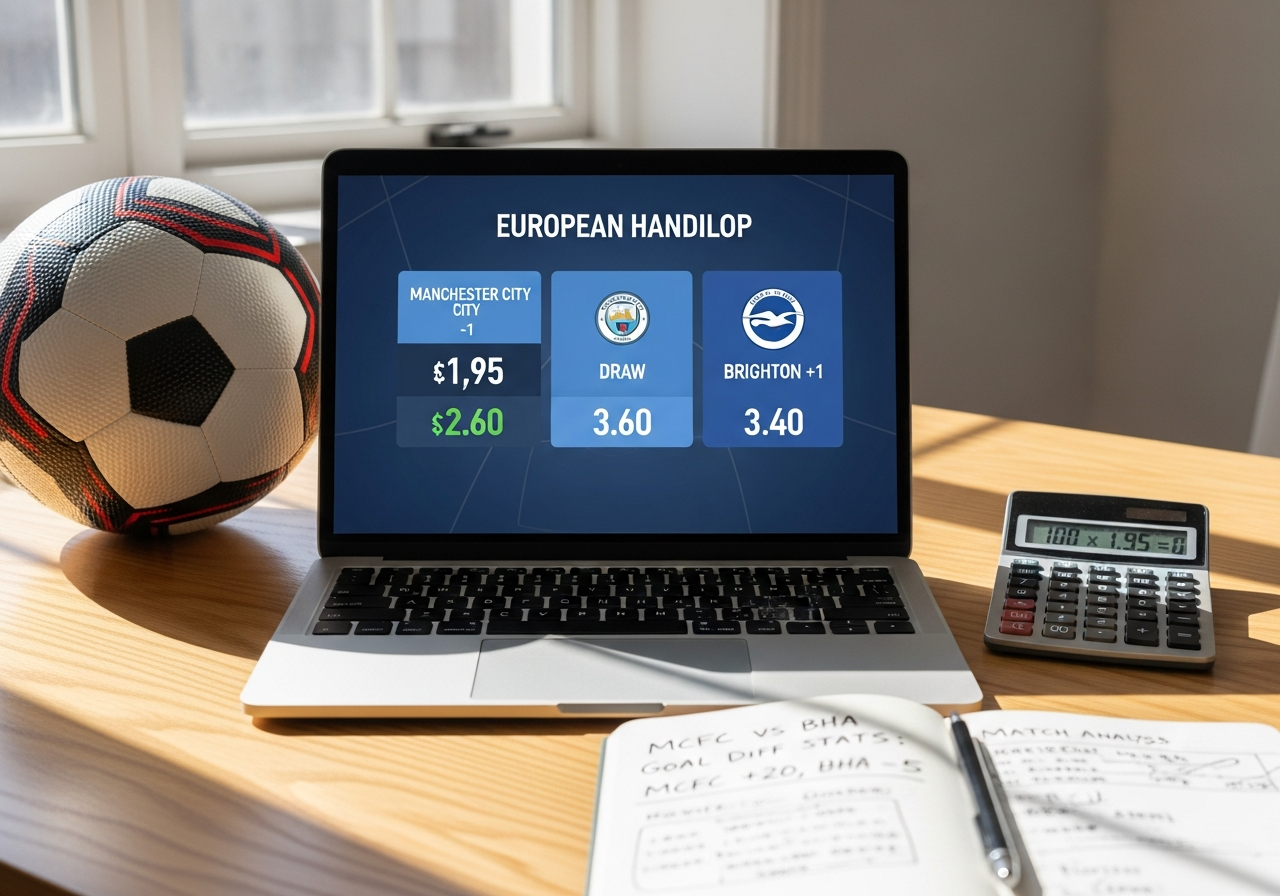
- Interpret the handicap notation – You’ll see three selections listed with their corresponding odds. For example:
- Manchester City −1 @ 1.80
- Draw @ 3.50
- Brighton +1 @ 4.20
- Select your chosen outcome – Click the odds for the selection you wish to back (e.g., the draw at 3.50).
- Confirm your stake and place the bet – Enter your stake amount in the bet slip, review the potential payout, and confirm. Your wager is now live.
Note on odds: Larger handicaps for the favourite (e.g., −3 vs −1) typically yield higher odds for that selection, reflecting lower expected win probability. Conversely, smaller handicaps produce lower odds. Compare bookmakers if a match is available across multiple sites; odds can vary significantly, and even small differences compound over many bets.
Legal and Responsible Betting Context in India
India’s gambling laws are restrictive. The Public Gambling Act of 1867 prohibits most gambling activities, with specific exceptions for lotteries and horse racing in certain states. Online sports betting is not explicitly legal under central law, though many states have not criminalized it for individual punters. Consequently, online betting exists in a grey area: offshore betting sites operate legally in their jurisdiction and accept Indian customers, but the Indian government’s stance remains ambiguous.
Before placing any bet, verify that your chosen site is licensed in a recognized jurisdiction (such as Malta, Curacao, or the UK) and explicitly accepts Indian players. Read the site’s terms and conditions carefully. Gamble only with reputable, established platforms. Most importantly, remember that gambling should be entertainment, not an income source. Only bet money you can afford to lose entirely. Never chase losses by increasing stakes; this is how problem gambling develops. If you feel your betting is becoming compulsive, seek help from responsible gambling organizations or counsellors in your region.
Bankroll Management and Risk with Handicaps
European handicap betting carries the same financial risks as any sports betting. Smart bankroll management is non-negotiable if you wish to sustain your activity over the long term.
- Use fixed unit staking – Bet the same amount (e.g., ₹500 per bet) on every European handicap wager, regardless of confidence level. This prevents catastrophic losses from a single bad run and keeps variance manageable. Never exceed 2–5% of your total bankroll on a single bet.
- Avoid concentrating on one match or line – Diversify across multiple matches and handicap lines each week. Never place your entire weekly budget on a single match, no matter how confident you feel. Even the best-researched bets can lose.
- Account for European handicap’s settlement certainty – Unlike Asian handicap, European handicap has no refund or push outcomes. Every bet on a European handicap line settles as a definite win or loss. Factor this into your risk calculation; you cannot expect a refund if your thesis partially fails.
- Track ROI, not just wins – Monitor your return on investment (ROI) across all European handicap bets. A positive long-term ROI (e.g., +5% after 100 bets) indicates a sound strategy; most bettors operate at a loss. If your ROI is negative after 50+ bets, revisit your selection criteria.
- Set a loss limit per session – Decide in advance the maximum loss you’ll accept in a single betting session. If you hit that limit, stop betting and resume the next day. This discipline prevents emotional decisions that often lead to larger losses.
Strategy Tips for European Handicap Betting in Indian Football Markets
Successful European handicap betting relies on identifying matches where the bookmaker’s handicap line does not reflect the true strength gap between teams. The Premier League and Champions League offer the most liquid markets and sharpest lines, but patterns often repeat across mid-table and lower-ranked fixtures.
Spotting mismatches is your primary edge. A top-four team facing a newly promoted side is a classic scenario for a -2 or -3 line. Analyze recent form: if the favourite has won its last five matches by an average of 2.3 goals, and the underdog has lost its last five by an average of 2.1 goals, the -2 line is likely accurate. However, if the underdog has recently strengthened its defence or the favourite is suffering key injuries, you might find value in the draw or away +2 option, where odds may be overpriced.
Use historical goal difference and conceding trends. Track each team’s average goals scored and conceded per match over the last 10–15 games. Calculate the expected margin: if Team A scores 1.8 goals per game and Team B concedes 1.2, expect roughly a 0.6-goal difference in A’s favour, plus home advantage (if applicable). If the market offers Team A at -1, the line is asking for more than historical data suggests. Look for value in the draw or Team B’s +1 option.
Match handicap size to realistic expected margins. Premier League matches rarely see 3+ goal margins unless one team is drastically weakened by injuries or form collapse. A -3 line should be rare; -1 and -2 are standard. Indian Super League matches, being less competitive, may see larger margins. Never chase a -3 or -4 line without strong evidence (e.g., 10+ consecutive wins by 3+ goals). These are traps for overconfident bettors.
Sample Champions League and domestic top-division matches first. These leagues have the deepest betting markets and most accurate lines. Once you’re comfortable reading and settling European handicap bets, explore less liquid markets (e.g., second divisions, cup competitions) where bookmakers may misprice lines due to lower information flow.
Common Mistakes Indian Bettors Make With European Handicaps
Avoid these frequent errors to improve your European handicap results:
- Miscalculating the adjusted score – The most common mistake is applying the handicap in the wrong direction. Remember: negative handicaps subtract from the favourite’s score; positive handicaps add to the underdog’s score. Double-check your arithmetic before placing a bet.
- Ignoring the three-way structure – Treat European handicap as a genuine three-way market, not a two-way home/away bet with a margin requirement. The draw is a distinct outcome and often offers value, especially when two teams are closely matched or defensive form is strong.
- Expecting favourites to “always” cover the line – Handicap lines are set by sharp bookmakers; they are rarely easy money. A team at -1 does not guarantee a two-goal win. Variance and injury, weather, and momentum shifts ensure that even justified lines lose frequently. Bet on edges, not guarantees.
- Confusing European and Asian handicap mechanics – Do not apply Asian handicap logic (e.g., push/void outcomes, fractional margins) to European handicap. European handicap always settles; there are no refunds. This difference affects your expected value calculation.
- Overestimating large handicaps – A -3 or -4 line suggests a massive gap. Unless the favourite is a top-tier team facing a relegation-form or semi-professional side, avoid these extremes. Upsets and defensive collapse are real; respect the uncertainty.
- Failing to compare odds across bookmakers – Different sites price the same European handicap market differently. Always compare odds for the three selections before betting. A difference of 0.05–0.10 in odds may seem small, but it compounds over many bets and can swing a marginally profitable strategy into a loss.
By understanding European handicap mechanics, learning to read and settle adjusted scores, and applying disciplined bankroll management, you’ll develop a systematic approach to football betting in India. The key is patience: avoid rushing into large bets, track your results honestly, and refine your selection criteria based on evidence, not emotion. European handicap offers a clean, three-way framework for analysing uneven matches—use it wisely.