







Betting on total cards has emerged as one of the most dynamic and underexplored markets in Indian football wagering, yet the discipline remains relatively unfamiliar to punters transitioning from cricket betting. While Indian bettors have long grown comfortable analyzing run totals, team aggregates, and extras in IPL and domestic cricket, the world of yellow and red card betting in the Indian Super League (ISL) and I-League operates on fundamentally different principles—though the analytical framework shares striking similarities. The card markets are growing rapidly because they offer distinct value opportunities: they are less subject to mainstream media hype than goals markets, they correlate with match intensity and tactical approach rather than pure skill, and they provide multiple betting angles from simple over/unders to niche player and team-specific propositions.
This article focuses primarily on total cards betting in Indian football, where the ISL and I-League now feature robust card markets on leading Indian betting platforms. We will explore how cards are counted and settled by different bookmakers, examine the statistical drivers of card totals in Indian domestic football, and build a practical, data-led framework for identifying value in over/under card lines. For punters with cricket betting experience, we will include a comparative section showing how the process of analyzing run totals translates into forecasting cards—the mental models overlap even though the underlying variables are entirely different.
Understanding Total Cards Markets in Indian Football and Cricket
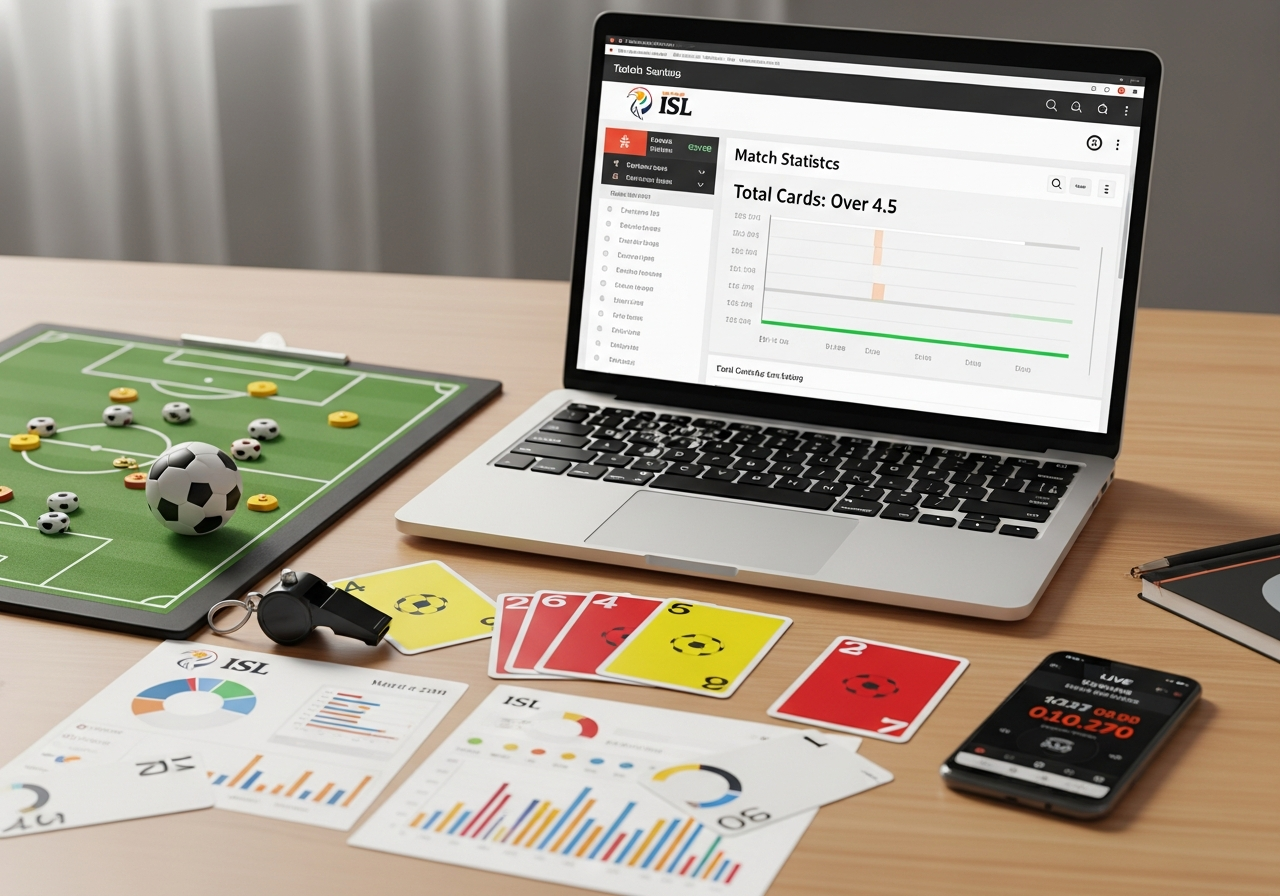
Total cards betting is fundamentally an over/under market where the bookmaker sets a line (typically 3.5, 4.5, or 5.5 cards per match) and you wager that the actual number of cards shown will exceed or fall short of that threshold. The settlement depends entirely on how the bookmaker defines and counts cards: a yellow card is almost universally valued at 1, but red cards may count as 1, 2, or even be excluded depending on the sportsbook’s rules. Understanding these counting rules before placing a bet is crucial, because a single rule discrepancy can flip the expected outcome of a prediction.
What Is Total Cards Betting?
At its core, total cards betting asks a simple question: will this match see more or fewer disciplinary cards than the line suggests? A bookmaker might offer over 4.5 yellow cards at evens, meaning you need at least 5 yellows to win. Conversely, under 4.5 yellows at the same odds means the match sees 4 or fewer yellows. Most Indian platforms display these lines alongside other match statistics (goals, corners, possession) and allow you to combine card bets with other legs in a bet builder.
The appeal lies in the fact that card lines are less volatile than goal markets and often reflect mispricing when teams or referees have strong disciplinary tendencies. For instance, if two aggressive sides with histories of high foul counts meet, the over 4.5 line may still be set at standard odds, even though historical data suggests cards should be much more likely.
How Cricket Totals Differ From Card-Based Markets
Cricket totals betting in the IPL and domestic T20 leagues focuses almost entirely on run aggregates: a match total (combined runs by both teams), a team total (runs by one side), or extras (wides and no-balls). These are continuous variables driven by batting form, bowling quality, pitch conditions, and match situation. Card-based markets in football, by contrast, measure disciplinary events that are discretionary (a referee must decide to issue a card) and largely independent of the final result.
The key similarity is structural: both use over/under lines and require bettors to forecast a number. An IPL punter who has learned to estimate whether a T20 match will yield 350+ total runs using pitch reports, recent form, and powerplay aggression can apply that same estimating mindset to cards—but must swap the input variables. Instead of batting units and strike rates, you are analyzing fouls per 90 minutes, referee card rates, and tactical aggression. The process is analogous; the data is different.
Bookmaker Rules for Total Cards and Booking Points
Before placing a card bet, you must understand precisely how your chosen bookmaker counts cards. Rules vary more than many punters realize, and these differences can determine whether a bet wins or loses.
| Bookmaker/Rule Set | Yellow Card Value | Red Card Value | Max Cards per Player | Special Notes (Managers, Extra-time) |
|---|---|---|---|---|
| Standard UK/EU Model | 1 per yellow | 1 per red | Capped at 2 yellows + 1 red (dismissed) | Manager/coaching staff cards usually excluded; extra-time cards count |
| Booking Points Index | 10 per yellow | 25 per red | Multiple reds possible in theory, but rare | Used for accumulator bets; higher red weight means over lines shift upward |
| Asian Handicap Books | 1 per yellow | 1–2 per red (varies) | Straight red = 1 card, double yellow + red = 2 cards | May count tactical fouls differently; check settlement page |
| Indian Platform A (Typical) | 1 per yellow | 1 per red | Capped per player as per law | Excludes manager/bench cards; includes all match time + injury time |
| Indian Platform B (Typical) | 1 per yellow | 1 per red | Capped per player as per law | Same as above; emphasize reading their specific rules |
Card Counting Conventions Across Major Books
Most mainstream bookmakers (and the majority of Indian platforms) count each yellow as 1 and each red as 1, with no multiplier. However, booking points indexes—often used in accumulators and bet builders—assign 10 points per yellow and 25 points per red, effectively weighting red cards more heavily. This means a booking points line of 35+ might be reached with two yellows and one red (10+10+25=45), or four yellows and no reds (10+10+10+10=40). These weighted indexes are useful for punters who want to distinguish between different card severities, but they require careful interpretation.
Additionally, some bookmakers will not count a card issued after the final whistle (if a player or manager reacts after the match ends), while others include injury-time cards. A few platforms also exclude manager and coaching staff cards, counting only on-pitch player cards. You must confirm these details on each sportsbook’s settlement page before committing money. The difference between a 4.5 and 5.5 line might determine your entire profit or loss, so reading the fine print is not optional.
Main Types of Card and Total Markets Indian Punters Use
Indian football betting platforms now offer a diverse suite of card-related markets beyond simple total cards over/unders. These include player-specific props, team aggregates, and specialized booking indexes that cater to different betting styles.
- Total Cards (Over/Under): The most straightforward market. Bet on whether the match will see more or fewer cards than a set line (typically 3.5 to 5.5 for ISL matches).
- Booking Points: A weighted index where yellows count as 10 points and reds as 25 points. Over/under lines are set on the total points, allowing you to bet on a severity-adjusted card count.
- Player to Be Carded: Wager on whether a specific player (usually a known aggressor or midfielder) will receive at least one card during the match.
- Team with Most Cards: Bet on which team will accumulate more cards. Useful when one side is expected to be more aggressive or indisciplined.
- First/Last Card: Predict which player will receive the first or last card of the match. Often offered at longer odds.
- Card Handicaps: Similar to goal handicaps, these give one team a head start or deficit in the card count (e.g., “Team A -1 cards vs. Team B +1 cards”) and allow you to bet on the adjusted spread.
- Bet Builders with Cards: Combine card propositions with goals, corners, or results to create custom accumulator bets with boosted odds.
Total Cards vs Booking Points
Total cards is the pure count: each card (yellow or red) equals 1, regardless of severity. If a match produces 3 yellows and 1 red, the total cards is 4. Booking points, by contrast, weights outcomes: the same 3 yellows and 1 red would yield 10+10+10+25=55 points. A booking points over/under line of 50.5 would be over; a total cards over/under of 4.5 would also be over. However, the sensitivity differs. A match with 6 yellows and 0 reds scores 6 total cards (over 4.5) but only 60 booking points (over 50.5). For extreme scenarios—many yellows, few reds—total cards is more sensitive. For balanced cards, booking points emphasizes the rare but impactful red.
Most Indian bettors start with total cards over/unders because they are simpler to interpret. Booking points are useful if you believe a match will have a high proportion of reds (e.g., a heated derby with tactical fouls), in which case the booking points line may offer better value.
Player and Team Card Props
Player to be carded markets are highly useful in ISL because team compositions are stable and known aggression levels vary significantly between players. A midfielder with a history of yellow cards in previous seasons is a safer bet than a defender known for clean play. Team with most cards is valuable when one side has a clear disciplinary disadvantage (newly promoted teams or those with volatile temperaments often accumulate more cards). First/last card bets are novelty props but can offer overlay value if you identify a likely culprit early or late in a match. Card handicaps are less common on Indian platforms but are growing and provide a way to balance heavily mismatched teams.
Using Statistics to Assess Total Cards Value in Indian Football
Predicting total cards requires a blend of historical statistics, tactical context, and referee-specific data. Unlike goal-scoring, which is influenced by quality and form, card counts are largely driven by fouls, aggression, and refereeing standards. This makes card markets more predictable if you have access to the right data.
| Stat Type | What It Measures | How It Impacts Total Cards | Example Use in ISL Match |
|---|---|---|---|
| Cards per Game (CPG) | Average cards issued per match for a team or across a league | Teams with high CPG (>5.5) are likely to see overs in their matches | If Team A averages 6 cards/game and Team B averages 5.5, combined expected cards ~5.5–6.5 |
| Fouls per 90 Minutes | Total fouls committed by a team per 90 minutes | Higher fouls strongly correlate with higher card rates; typically, 1 card per 8–10 fouls in competitive leagues | A team averaging 14 fouls/90 is likely to accumulate 1.4–1.75 cards per match |
| Referee Card Rate | Average cards issued per match by a specific referee | Some referees are notoriously lenient; others issue 6+ cards per match regularly | Checking the referee’s recent history can swing an over/under line by half a card in expected value |
| Home/Away Splits | How disciplinary records change depending on venue | Teams may be more aggressive at home; away teams sometimes receive harsher card treatment from referees | An ISL team with 6 CPG at home vs. 4.5 away is a useful angle for home vs. away predictions |
| Tactical Style | Possession-heavy vs. counter-attacking vs. direct play | Possession-heavy teams often foul less (they control the ball); direct, physical teams foul more and attract more cards | Two possession-focused sides may see under 4.5; two physical counter-attacking teams may see over 5.5 |
| Recent Form / Motivation | Injury absences, team cohesion, match importance | Injuries can force tactical shifts to more physical play; crucial matches (derbies, playoffs) see higher intensity and more cards | An ISL derby or playoff match typically sees +1.5 cards vs. a regular-season fixture |
Key Discipline Metrics: Cards per Game, Fouls, Referee Trends
To forecast expected total cards for an ISL fixture, combine three elements: (1) the average cards per game for both teams, weighted by their recent form; (2) the known foul counts per 90 minutes for both sides (if available); and (3) the specific referee’s historical card rate.
Start with each team’s cards per game over their last 10–15 matches. If Team A averages 5.8 CPG and Team B 5.2 CPG, a naive expectation is around 5.5 combined cards. However, refine this by checking if one team is in a period of elevated fouls (suggesting tactical frustration) or if key players are suspended (forcing a more defensive, physical approach). Next, cross-reference the assigned referee. If the referee has issued 6+ cards in their last five matches, shift your expected total upward by 0.5–1 card. Conversely, a lenient referee with an average of 3.5 cards per match would suggest a downward adjustment.
Finally, consider tactical matchup and context. If one side is a possession-based team facing a physical, counter-attacking opponent, the possession side will likely foul less. An ISL derby or high-pressure fixture typically adds 1–1.5 cards to the baseline expectation. Aggregate these inputs into a realistic range (e.g., “I expect 4.5–5.5 cards”) and compare it to the bookmaker’s line. If the line is set at 4.5 over/under and you forecast 5–6 cards, over is valuable.
Strategic Approaches to Total Cards Betting in Indian Matches
Card betting requires a disciplined, value-focused mindset. The edge comes not from prediction accuracy alone, but from identifying situations where the bookmaker’s line is misaligned with your expected card range.
- Identify a Baseline Expected Card Range: Before consulting odds, estimate the most likely total cards for the match using the metrics outlined above (CPG, fouls, referee, tactical matchup). Aim for a specific range, not a point prediction—e.g., “4.5–5.5 cards” rather than “exactly 5 cards.”
- Compare Your Range to the Bookmaker’s Line: If your range is 4.5–5.5 and the line is set at 4.5 over/under, the market is offering you roughly fair odds for over (since your midpoint is 5). However, if the line is 3.5, the market is underpricing the over significantly—a strong value signal.
- Evaluate Implied Probability vs. Historical Frequency: Bookmakers set lines based on implied probability. An over 4.5 at -110 odds (roughly -105 in India) implies ~52% probability. Cross-check this against your own estimate. If you believe the true probability is 58–60%, you have found value.
- Avoid Chasing Odds in High-Variance Markets: Card markets can be volatile. A single early red card can swing the match dynamics entirely. Set a stake limit per match (e.g., 1–2% of bankroll) and stick to it regardless of line movement.
- Track Results Separately by Market: Maintain a ledger specifically for total cards bets. Over time, this allows you to identify whether your modeling is sound or if you have systematic blind spots (e.g., you consistently underestimate home team cards in ISL derbies).
- Shop for Lines Across Platforms: Different Indian platforms may offer slightly different lines (3.5 vs. 4.5) or odds. Seeking a 0.5 card difference or a 10–20% odds upgrade compounds into long-term ROI gains.
Pre-Match Strategy for Over/Under Total Cards
A pre-match workflow for ISL might proceed as follows: (1) note the two teams, the venue (home/away), and the assigned referee; (2) pull cards per game and recent fouls data for both teams; (3) check the referee’s last five matches for average cards issued; (4) assess the tactical matchup (possession vs. physical, any suspensions or injuries forcing tactical changes); (5) adjust for context (derby, playoff, league position relevance); (6) synthesize into an expected range (e.g., 4.5–5.5 cards); (7) compare to the bookmaker’s line and implied probability; (8) if the implied probability is significantly lower than your estimate, bet over; if significantly higher, bet under.
This entire process should take 15–20 minutes per match. The goal is to ensure that every bet is grounded in a quantifiable reason, not intuition or recent memory bias.
Live Betting on Cards During Indian Matches
Live card betting introduces real-time adjustments. Early bookings shift expectations significantly. If two yellows are issued in the first 10 minutes, the baseline expected total for the full match might increase by 0.5–1.5 cards (the early card rate is rarely sustained). Conversely, if no cards appear in the first 30 minutes and the teams are playing cautiously, scale back your forecast.
Watch for in-match indicators: does one team suddenly become more physical or frustrated as the game progresses? Is the referee calling fouls tightly or permissively? If a key player or goalkeeper is booked early, does that shift the team’s tactical approach toward more fouling? Live odds will adjust to these signals, but often with a lag. If you have a strong conviction based on early-match evidence (e.g., the referee is calling a very tight game and 3 cards have appeared by minute 15), a live over/under bet at that moment may offer sharp value.
The risk with live betting is emotional chasing. After one team goes down a goal, desperate fouling often follows, inflating the card total. This is logical, but if you have already placed an under bet and it turns bad due to this pattern, resist the urge to chase with an over bet in the same match. Stick to your pre-match discipline.
Comparing Football Total Cards to Cricket Totals for Indian Bettors
For Indian bettors experienced in IPL run totals, the conceptual shift to card totals is substantial but navigable. Both markets operate on over/under lines and require forecasting a numerical outcome. The analytical process—compiling data, identifying trends, estimating expected ranges—transfers directly. However, the drivers, volatility, and correlation with results differ fundamentally.
| Aspect | Football Total Cards | Cricket Match/Team Total Runs | Implications for Betting Strategy |
|---|---|---|---|
| Primary Driver | Fouls, aggression, referee standards | Batting form, pitch conditions, bowling quality | Card totals are more stable and repeatable; run totals are more volatile and context-dependent |
| Data Availability | Cards per game, fouls per 90, referee history | Team averages, recent form, powerplay strike rates | Card data is more consistent across sources; cricket has more noise from variable pitch/weather |
| Correlation with Result | Weak (high cards do not guarantee a team wins) | Strong (higher team runs strongly correlate with winning) | Card betting is independent; run total betting blends prediction with outcome hedging |
| Line Volatility | Moderate; adjusted based on ref and team form | High; adjusted based on pitch reports, toss, injury news | Card lines shift less frequently; run lines shift dramatically on new information |
| Reversions to Mean | Fast (card rates per team are sticky season-to-season) | Slower (team form fluctuates more) | Card systems are more predictive long-term; cricket requires more match-specific analysis |
| Bet Sustainability | High (cards per game remain consistent across seasons) | Variable (form cycles, injuries, and pitch variation) | Card betting strategy can be more consistent; cricket requires seasonal recalibration |
Translating Run Totals Experience into Card Markets
If you have built a successful IPL totals model based on batting averages, recent form, and pitch reports, adapt it to cards by substituting the input variables. Replace “team batting average runs in powerplay” with “team fouls per 90 in the opening 30 minutes.” Replace “bowling attack quality” with “referee card rate.” Replace “pitch report (fast, slow, turning)” with “tactical style (possession-heavy, physical, counter-attacking).”
The methodology remains identical: gather historical data, identify variables that correlate with the outcome (total runs in cricket, total cards in football), filter for recent performance, estimate a range, compare to the market line, and identify value. The key difference is that card outcomes are less influenced by binary events (a pitch is either suitable for batting or bowling) and more influenced by continuous variables (referees issue cards on a spectrum, team fouls per 90 vary continuously). This makes card markets somewhat less volatile but also less subject to dramatic overnight swings caused by external shocks (like a rain-affected pitch in cricket).
Indian Market Focus: ISL Card Betting and Local Bookmakers
The Indian Super League has grown substantially in recent years, and with it, the availability of disciplinary markets on domestic platforms. Most Indian betting sites now group total cards alongside goals, corners, possession, and other match statistics, making cards a standard offering rather than a niche exotic.
- Total Cards Over/Under: Available on virtually all Indian platforms, typically with lines from 3.5 to 5.5. Usually displayed prominently in the match stats section.
- Team with Most Cards: Offered on many platforms as a straightforward head-to-head proposition or as part of a bet builder.
- Player to Be Carded: Available for key players on both teams; popularity varies by platform but is growing.
- Booking Points Accumulators: Some platforms offer booking point indexes as alternative to pure card counts, useful for multi-leg bets.
- Card Handicaps and Props: Less common but increasingly available on premium platforms; examples include “Team A to receive 2+ more cards than Team B” or “Both teams to receive 4+ cards.”
- Live Card Markets: In-play over/unders on remaining cards in the second half or remaining time, allowing mid-match adjustments.
Popular Card Markets on Indian Football Betting Sites
Indian platforms typically bundle card markets with goals, corners, and other match props under a “Match Stats” or “Markets” tab. This positioning reflects their mainstream appeal among Indian punters. Many sites allow you to build custom bets by combining a total cards over/under with a goals over/under or a result prediction, creating multi-leg accumulators with boosted odds. Popular bookmakers in India (and their regional affiliates) now prioritize card markets because punters recognize the value and the markets are less manipulated by high-volume bettors than goal markets.
The settlement speed is typically fast: within minutes of the final whistle, cards are tabulated and bets are marked as won or lost. This is important for live punters and accumulators, where cash-out requests may be pending final settlement.
League-Specific Angles: Indian Super League Discipline Trends
The ISL, now in its ninth season, has developed distinct disciplinary patterns that savvy bettors can exploit. Certain teams are consistently aggressive: teams with high-intensity pressing and counter-attacking tactics accumulate more fouls and cards. Newly promoted teams sometimes show elevated card counts in their first ISL season due to tactical unfamiliarity or overaggressiveness. Home teams at packed stadiums (especially in derbies) may receive lighter refereeing from the home crowd effect, or conversely, may be more aggressive.
Travel and fixture congestion also matter: ISL teams that have just played a midweek cup match or travelled long distances may be fatigued and prone to fouling. Reviewing recent ISL seasons, certain matchups are notably higher-card fixtures (e.g., derbies between traditional rivals like FC Goa and Kerala Blasters, or matches involving teams with known aggression issues).
Building a personal database of ISL team discipline profiles—cards per game, home vs. away splits, performance against specific opponents—is invaluable. Over a single ISL season, a disciplined bettor who focuses exclusively on card markets in ISL fixtures can identify repeatable patterns that the market has not yet priced.
Risk Management, Bankroll Control and Edge in Total Cards Betting
Card betting, like all sports betting, carries inherent risk. Markets can be illiquid (especially player-to-be-carded or first-card bets), odds can shift rapidly before matches, and variance means that even a well-calibrated model will experience cold streaks. Sustainable card betting requires disciplined bankroll and risk management.
| Approach | Pros for Card Betting | Cons/Risks | Typical Use Case in Indian Matches |
|---|---|---|---|
| Fixed Unit Staking (1–2% of bankroll per bet) | Simple, predictable drawdowns, prevents ruin, allows recovery | Leaves long-term winnings on the table compared to optimal Kelly; lower unit size limits upside | Recommended for most bettors; ensures longevity even with 50% hit rate |
| Selective Betting (only bets with >52% EV) | Concentrates capital on high-confidence plays; aligns with value-only philosophy | May result in long gaps without bets; requires disciplined restraint; easy to rationalize weak-EV bets under pressure | Ideal for experienced bettors with strong discipline; best for ISL fixtures where you have deep team data |
| Bet Builders (card + goals + result) | Boosts odds, offers hedge potential (e.g., over cards + under goals as a contrarian parlay) | Increases variance; if any leg fails, entire bet loses; harder to track true ROI by market | Use sparingly; reserve for occasions where you have edge on multiple legs simultaneously |
| Opposing Bets in Derbies (under cards on one side, over on another) | Reduces variance, allows positioning around uncertain match intensity | Complex, requires more capital, and may cancel out edge if neither side offers true value | Avoid unless you have strong conviction on direction and asymmetric team discipline profiles |
Building Sustainable Card-Focused Betting Habits
The foundation of long-term card betting is discipline and record-keeping. Start by committing to a fixed bet size (e.g., 1% of bankroll per card bet) and maintaining a spreadsheet that tracks every bet: the match, your expected card range, the line and odds offered, the result, and the profit or loss. Over 50–100 bets, you will see whether your card forecasting model is sound or systematically biased.
Cap your exposure per match—never stake more than 2–3% of your bankroll on a single ISL fixture, regardless of confidence. Derbies and high-profile matches attract emotional betting; resist the temptation to oversize bets on these fixtures even if your model suggests a strong edge. Maintain a separate “card betting” bankroll if you are diversifying across multiple betting markets, and never allow losses in one market to trigger chase bets in another.
Finally, prioritize leagues and platforms with clear settlement rules and accessible historical data. The ISL is ideal because fixture lists are transparent, referee assignments are published, and historical card data is available through aggregator sites and the ISL’s official records. Avoid niche international lower-league matches where settlement rules are opaque or data is sparse. Focusing on a single league (ISL, I-League, or even IPL cricket totals if you prefer) builds deep expertise and allows you to identify repeatable market inefficiencies that casual bettors will never notice.
Sustainable card betting is not a path to rapid wealth; it is a methodical process of building an edge through superior data analysis, disciplined process execution, and long-term bankroll management. For Indian bettors willing to invest the effort, however, card markets—far less crowded than goal or result markets—offer some of the best value on the board.