






Indian sports bettors have embraced online betting in growing numbers over the past decade, with football—both domestic Indian Super League (ISL) and international leagues like the English Premier League (EPL)—leading the charge. One reason for this enthusiasm is that football and similar sports naturally feature three possible outcomes per match: a home win, a draw, or an away win. Unlike sports where draws are rare or impossible, football presents a unique opportunity for bettors seeking reduced-risk strategies. Double chance betting has emerged as a popular vehicle for Indian punters to navigate this three-outcome landscape, offering a way to cover two of three possible results in a single bet.
Double chance betting simply means selecting a wager that covers two of the three possible match outcomes instead of just one. For example, you might bet on either a home win or a draw, or a draw or an away win. This market feels “safer” than traditional 1X2 betting because it eliminates one outcome from your loss condition. However, the tradeoff is that the odds are lower, reflecting the increased probability of your selection winning. In this guide, we’ll explore how double chance works, why it appeals to Indian bettors managing smaller bankrolls or seeking smoother results, and how to use it strategically within accumulators and live betting. We’ll also examine how regulatory context and responsible gambling principles apply, ensuring you make informed decisions on Indian-facing platforms.
What Is Double Chance Betting In Simple Terms
Double chance betting is fundamentally a way to reduce the number of losing scenarios in a match. In standard 1X2 betting, you pick one outcome: either the home team wins (1), there’s a draw (X), or the away team wins (2). If you select home and the match ends in a draw or away win, you lose. With double chance, you select two outcomes, so you only lose if the third outcome occurs.
For instance, imagine an ISL match between Kerala Blasters and Bengaluru FC. With standard 1X2 betting at odds of 1 (home) = 2.50, X (draw) = 3.20, and 2 (away) = 2.80, you must pick exactly one to win. A double chance bet of 1X (home win or draw) might offer odds of 1.40, combining the probability of Kerala winning or the match ending level. If Kerala wins or draws, you win the bet. Only if Bengaluru wins do you lose.
This difference is critical: double chance increases your winning probability but decreases your payout. To illustrate, if the true probability of a home win is 40% and a draw is 30%, your combined 1X probability is 70%—a significant cushion. Yet the odds you receive (say 1.40) reflect both that higher probability and the bookmaker’s margin. Compared to betting home at 2.50, the 1X at 1.40 feels “safer” but returns less per rupee staked. Over multiple bets, this lower-odds dynamic means you need higher hit rates to break even or profit.
Why Double Chance Needs A Three-Outcome Market
Double chance only makes sense in sports where a draw is a legitimate, commonly occurring result. Football is the prime example: draws happen in roughly 20–30% of matches across most leagues, making draws a substantial part of the betting landscape. Hockey and handball also feature draws, so double chance markets exist there. In cricket, certain formats like Test matches can end in draws, though the structure differs from football’s straightforward three outcomes. However, in sports like basketball, American football, or kabaddi—where draws are impossible or extremely rare—double chance betting either doesn’t exist or is structured differently (for example, as a two-outcome market).
The reason is mathematical: double chance aggregates two of three mutually exclusive outcomes. If no third outcome is possible, the market collapses into a simple win/loss proposition. Indian bettors following cricket should note that while some T20 leagues feature occasional ties, they’re rare enough that traditional double chance markets are not standard. The market relies on the draw being a meaningful, pricing-differentiating outcome.
Basic 1X, X2 And 12 Notation Explained
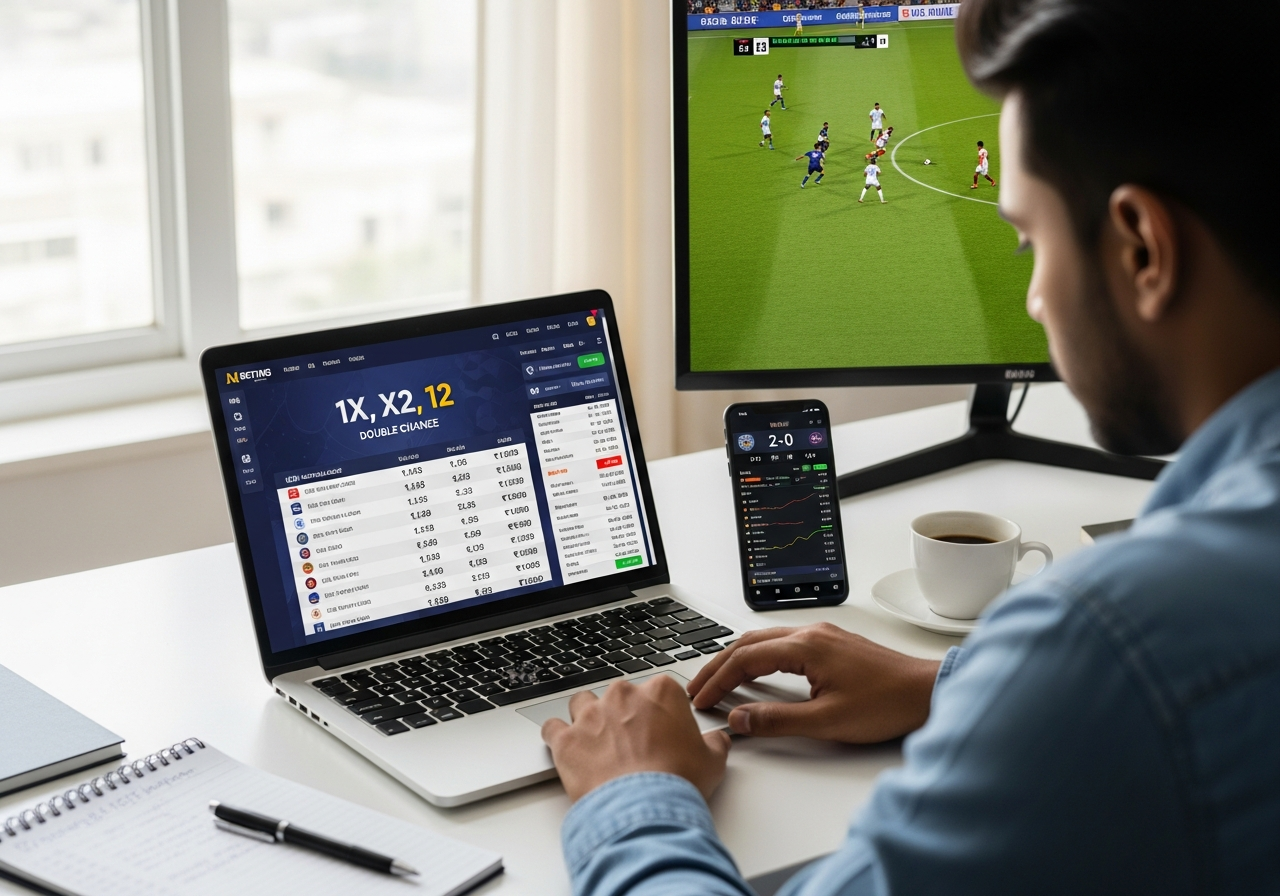
International betting platforms use shorthand notation to denote double chance options. 1X means home win or draw; X2 means draw or away win; 12 means either team wins (excluding the draw). These abbreviations come from the standard 1X2 notation, where 1 = home, X = draw, and 2 = away.
Consider a hypothetical EPL match: Manchester United (home) versus Chelsea (away). Typical 1X2 odds might be 1 = 1.80, X = 3.60, 2 = 4.20. The double chance options would be:
- 1X @ 1.30: Manchester United win or draw occurs (covers outcomes 1 and X).
- X2 @ 1.65: Draw or Chelsea win occurs (covers outcomes X and 2).
- 12 @ 1.35: Either Manchester or Chelsea wins; no draw (covers outcomes 1 and 2).
In an ISL context, a Mohun Bagan vs Jamshedpur FC match might offer 1X @ 1.40 if a home draw is highly likely, or X2 @ 1.50 if the visiting team has a strong defensive reputation. The notation remains universal, making it easy for Indian bettors using any regulated app to identify their desired market.
How Double Chance Works On Indian Betting Sites
The mechanics of placing a double chance bet on an Indian-facing sportsbook or app are straightforward, though understanding each step ensures you avoid errors and maximise bonus eligibility.
- Log in to your account and ensure your rupee wallet is funded via your preferred payment method (UPI, bank transfer, e-wallet, etc.).
- Navigate to the sport you wish to bet on—typically “Football” or “Soccer” is displayed prominently on the homepage.
- Select the match from the fixture list (e.g., an upcoming ISL or EPL fixture).
- Open the “Markets” or “Betting Options” section for that match and scroll to or search for “Double Chance.”
- Choose your double chance option (1X, X2, or 12) by clicking or tapping on it; the odds will display next to each option.
- Enter your stake in rupees in the bet slip panel (usually on the right side of the screen on desktop, or in a collapsible slip on mobile).
- Review the bet slip to confirm the match, double chance selection, odds, stake, and estimated return.
- Click “Place Bet” or “Confirm” to submit your wager; most apps will display a confirmation message with a unique bet ID.
It’s important to note that some promotional offers or bonus bets may exclude double chance markets or apply restrictions (for instance, minimum odds requirements). Before using a bonus, check the terms on your operator’s promotions page. Additionally, because rupee stakes are common among casual Indian bettors, most platforms now allow staking in multiples of ₹10 or ₹100, making it easy to manage unit sizes across different bets.
Reading The Double Chance Market On Your Bet Slip
Once you’ve selected a double chance option, your bet slip will display key information: the match name, the selected option (e.g., “1X”), the decimal odds (e.g., 1.35), your stake in rupees, and the estimated return (stake × odds). For example, if you stake ₹1,000 on a double chance at 1.35, your potential return is ₹1,350, with a profit of ₹350.
After the match concludes, settlement is automatic. If your selected outcomes occur, the bet is marked “Won” and your return is credited to your account within minutes. If the third outcome (the one you didn’t cover) happens, your bet is “Lost” and the stake is deducted. For instance, if you bet 1X at 1.35 and the match ends in an away win, your bet loses. There is no push or refund in standard double chance markets; unlike some Asian handicap bets, there are only two outcomes: win or lose.
Double Chance Vs Standard 1X2: Risk And Reward For Indian Bettors
| Feature | Standard 1X2 Bet | Double Chance Bet | Impact For Indian Bettors |
|---|---|---|---|
| Outcomes Covered | One of three | Two of three | Double chance reduces loss scenarios, appealing to conservative bettors |
| Typical Odds Range | 1.50–5.00+ depending on likelihood | 1.20–2.50 for most common options | Shorter odds mean smaller returns per rupee; volume is needed for profit |
| Volatility / Variance | High; single wrong pick kills slip | Lower; more picks need to miss to lose | Better for smaller bankrolls and building consistent weekly results |
| Hit Rate Required | ~60–70% to break even with typical odds | ~75%+ depending on average odds | Requires disciplined selection; casual bettors may hit high rate but still lose if odds are poor |
| Suitability: Beginner | Riskier; can lead to chasing losses | Better starting point if combined with other tools | 1X or X2 on strong logical picks reduces emotional volatility |
| Suitability: Advanced | Preferred if strong edge on specific outcome | Useful as hedge or for accumulators | Professionals use it selectively; rarely primary weapon |
| Bankroll Smoothing | Requires discipline and larger capital | Easier to maintain steady activity | Indians with ₹5k–₹20k monthly budgets find it easier to sustain |
| Expected Return (ROI) | Higher if edges found (can exceed 20–30%) | Lower if relying only on safety (often 2–5%) | Temptation to “play it safe” can lead to break-even or slight losses long-term |
Worked Odds Example For An ISL Or EPL Match
Let’s work through a concrete example. Suppose you’re examining a mid-season ISL match: Kerala Blasters (home) versus Hyderabad FC (away). The sportsbook offers these 1X2 odds:
- 1 (Kerala Win): 2.40
- X (Draw): 3.00
- 2 (Hyderabad Win): 2.70
To calculate implied probabilities, use the formula: Implied Probability = 1 / Odds.
- Kerala Win: 1 / 2.40 = 0.417 (41.7%)
- Draw: 1 / 3.00 = 0.333 (33.3%)
- Hyderabad Win: 1 / 2.70 = 0.370 (37.0%)
Total: 41.7% + 33.3% + 37.0% = 112.0%. The extra 12% is the bookmaker’s overround (margin).
Now, the double chance options offered are:
- 1X: 1.50
- X2: 1.60
- 12: 1.45
Let’s check the 1X option. If you combine Kerala Win (41.7%) and Draw (33.3%), your “true” probability (ignoring margin) is 75%. However, the bookmaker applies margin to this combined option. At 1.50, the implied probability is 1 / 1.50 = 0.667 (66.7%), which is lower than your calculated 75%. This suggests the 1X at 1.50 might be slightly overpriced—a potential value spot. Conversely, if the 1X were offered at 1.35, the implied probability would be 74%, which fairly reflects the combined probability and is not exceptional value.
This worked example shows that even though double chance feels safer, you must still verify the odds reflect fair value. Blindly betting short-priced 1X or X2 bets will, over time, result in small losses or marginal returns if the market is consistently taking away value to pay its overhead.
When Straight 1X2 Might Be Better Than Double Chance
There are scenarios where opting for a straight 1X2 bet instead of double chance makes more sense. If you have strong conviction on a specific outcome—say, you’ve analysed team form, head-to-head records, and injuries and believe Kerala is significantly more likely to win than draw—then betting the outright 1 at 2.40 offers better expected value than covering the draw with 1X at 1.50. The higher odds compensate for the narrower coverage.
Underdogs also represent a common case. If Hyderabad is perceived as a weak away side but you identify a structural advantage (e.g., Kerala’s midfield injuries), backing Hyderabad to win outright (2) at 2.70 might yield higher returns than hedging with X2 at 1.60. The added odds offset the reduction in probability that pure safety provides. Additionally, if you’re chasing higher returns for a specific week or are confident in a particular bet, the lower payout of double chance may not align with your goals.
Understanding Odds, Probabilities And Bookmaker Margins
Bookmakers don’t simply set odds to reflect the true probability of outcomes; they incorporate a margin to ensure profitability regardless of the result. This margin, called the overround, is built into all odds. For double chance markets, which combine two probabilities, understanding this structure is vital for spotting value.
In the ISL example above, the 1X2 odds implied a total overround of 12%. This is typical; most major European and Indian sportsbooks operate with overrounds of 4–8% in mainstream markets. When a double chance option like 1X is offered, the bookmaker applies a similar margin to the combined probability. A “fair” double chance price reflects the sum of the two outcome probabilities plus the bookmaker’s standard margin. If the margin is applied unevenly (e.g., the bookmaker shades one double chance option tighter than others), an opportunity for value arises.
For Indian bettors managing modest bankrolls in rupees, spotting these small inefficiencies over dozens of bets compounds into meaningful long-term profit. The challenge is that most casual punters don’t perform this calculation; they simply bet on what “feels safe,” which leads to consistent small losses as margins erode returns.
Simple Way To Check Value On Double Chance Bets
Here’s a step-by-step process to quickly assess whether a double chance bet offers value without heavy mathematics:
- Collect the 1X2 odds for your match from your preferred sportsbook or another operator; compare them to your current book’s odds to spot any discrepancies.
- Convert to implied probabilities using 1 / Odds: if 1 = 2.40, then P(1) = 41.7%; if X = 3.00, then P(X) = 33.3%; if 2 = 2.70, then P(2) = 37.0%.
- Add the two relevant probabilities for your double chance option: for 1X, add P(1) and P(X) = 41.7% + 33.3% = 75%.
- Calculate the bookmaker’s margin from the total: (1 / 2.40) + (1 / 3.00) + (1 / 2.70) ≈ 0.112 or 11.2%; this is the standard markup.
- Adjust your combined probability by the margin: 75% / 1.112 ≈ 67.4%; this is a rough “fair” implied probability for the double chance option.
- Compare with the offered 1X odds: if 1X = 1.50, the implied probability is 66.7%, which is slightly lower than 67.4%, suggesting minor overpricing. If 1X = 1.60, the implied probability is 62.5%, indicating significant overpricing relative to the underlying 1X2 odds.
This method isn’t perfectly precise, but it gives Indian bettors a quick mental check to avoid betting reflexively on every double chance that “feels safe.”
Common Double Chance Options In Football And Other Sports
| Double Chance Option | Covered Outcomes | Typical Use Case | Notes For Indian Bettors |
|---|---|---|---|
| 1X (Home or Draw) | Home win + Draw | Backing the favoured home team while protecting against an upset; ideal when home advantage is strong and you expect either a win or a defensive stalemate. | Popular in ISL where home teams often dominate; also common in EPL for backing Liverpool, Man City when they’re heavy odds-on. |
| X2 (Draw or Away) | Draw + Away win | Backing the away team’s resilience or predicting a tight match where a draw is as likely as an away upset; useful when away sides are typically strong (e.g., in European competitions). | Less frequently used by Indian punters than 1X; more relevant for away teams with strong defensive records, such as Bengaluru in ISL. |
| 12 (Either Team Wins, No Draw) | Home win + Away win | Betting on an open, attacking match with a decisive result; eliminating the draw when you expect few goals prevented or high volatility. | Common in leagues with lower draw rates or on specific weekends when multiple attacking teams play; less applicable in defensive leagues. |
| 1 (Home Win Only) | Home win only | Straight betting without protection; maximum odds and minimal coverage; for bettors with strong conviction. | Standard 1X2 option; higher variance but better payout if prediction is correct. |
| X (Draw Only) | Draw only | Niche market; useful when two teams are evenly matched and you expect a tactical stalemate. | Rare in India; mostly relevant for matches between historically equal-strength clubs or when weather/pitch conditions suggest a grind. |
| 2 (Away Win Only) | Away win only | Straight betting on the underdog or away side; maximum odds but minimal coverage; for strong conviction on specific away upset. | Popular among experienced Indian bettors backing underdog away sides in ISL; higher risk, higher reward. |
Double chance markets are standard in football and hockey. In cricket, the three-outcome structure exists in Test cricket (home win, draw, away win), but draw rates vary by series and format, so double chance pricing can be volatile. For other sports Indian bettors follow, such as kabaddi, traditional double chance markets are not offered because ties are rare or structured differently.
How Double Chance Interacts With Draw No Bet And Asian Handicap
Draw No Bet (DNB) is a related market that refunds your stake if the match ends in a draw. It differs from double chance in a key way: with DNB on a home team, if the match draws, you get your stake back (no loss, no win). With 1X double chance, you win. This means DNB is riskier than 1X (your money is refunded but not multiplied on a draw), yet DNB offers slightly higher odds than 1X because you’re not covering the draw as a win.
For example, 1X might be 1.50, while Draw No Bet (home) might be 1.60. DNB appeals to bettors who want to “remove” the draw without backing it as a positive outcome. However, in terms of expected value, 1X is often more attractive because you’re being paid on the draw, whereas DNB merely returns your stake.
Asian Handicap is a different beast entirely. It removes the draw by assigning a goal handicap to one team. For instance, a -0.5 handicap on the favourite means the favourite must win by at least one goal for you to win; a draw or away win loses. A 0 handicap (level) refunds your stake if the match ends level. Asian handicaps apply uniformly across accumulators and offer fixed odds, whereas double chance odds vary.
For Indian bettors, double chance is simpler than Asian handicap conceptually and doesn’t require understanding negative goal lines. However, Asian handicap can offer better value on specific matches, especially when you’re confident in a team’s margin of victory. Choose based on your analysis: if you simply want to back a team avoiding defeat, 1X is clearer; if you think a team will win by multiple goals, explore Asian handicap alternatives.
Impact Of League Style And Team Profile On Double Chance
League characteristics heavily influence which double chance option is attractive. The English Premier League, for instance, has an average draw rate around 24%, meaning roughly one in four matches ends level. This relatively high draw frequency makes 1X and X2 bets frequent and competitive. Indian bettors following EPL clubs can expect solid value on double chance markets.
The Indian Super League, while younger, has seen draw rates around 20–25% in recent seasons, supporting active double chance trading. Home advantage is particularly pronounced in ISL, with home teams winning approximately 40–45% of matches compared to away teams winning 25–30% and draws at 25–35%. This skew suggests 1X on strong home teams (e.g., Mohun Bagan at home) is often underpriced relative to the straight home bet, offering value.
Defensive leagues or tournaments with lower-scoring patterns (e.g., some cup competitions) tend toward higher draw rates, making 1X and X2 more appealing. Conversely, leagues with many attacking teams (e.g., certain seasons of La Liga) show lower draw rates, making 12 (either team wins) more relevant.
Team profile matters similarly. A team known for tight defence and rare defeats (e.g., a top-six EPL club early in a season) makes their 1X attractive because the combined probability of a win or draw is very high. An away team with strong defensive discipline makes X2 appealing. Monitoring recent form, goal differentials, and head-to-head matchups helps identify when double chance odds drift away from fair value.
Strategic Uses Of Double Chance For Indian Punters
- Protect marginal selections in parlays: Mix straight win picks with 1X or X2 selections on matches where you’re less certain, reducing the risk that a single upset destroys your entire slip while keeping total odds reasonable.
- Back underdogs strategically: Lay a modest stake on an underdog with a draw (X2) or outright win (2), and hedge a larger portion with 1X on the favourite, locking in a manageable loss if the favourite stumbles.
- Build consistent weekly activity: Stake smaller amounts on multiple double chance bets rather than chasing big odds on straight wins; over weeks and months, this yields more stable results and avoids emotional swings.
- Reduce variance on limited bankroll: Indian bettors with ₹5,000–₹20,000 monthly budgets often favour higher hit rates and smaller returns per bet; double chance aligns with this profile by increasing win frequency.
- Exploit home advantage in ISL: Use 1X heavily on established home teams in Indian football, where home advantage is structural and bookmakers sometimes price the draw too high relative to the home win.
- Ladder small accumulators: Combine two or three 1X bets on lower-league or less-scrutinised matches to achieve 2.5–4.0 total odds without the risk of pure-play accumulators, which can collapse on a single result.
- Pre-match scanning: Scan available double chance options across multiple operators to identify one bookmaker systematically offering value (e.g., 1X prices 5% better) and concentrate volume there.
Using Double Chance As An Accumulator Stabiliser
Accumulators (or “kombis”) are popular with Indian bettors because they offer the allure of multiplying small stakes into large payouts. A five-leg accumulator at 1.50 per leg yields 7.59 total odds—impressive. However, a single loss on any leg collapses the entire slip. This fragility is why experienced Indian punters use double chance to stabilise accumulators.
Suppose you’re building a three-leg slip. You have strong conviction on a European match (back the favourite at 1.80 for a straight win) and two ISL matches where you’re moderately confident (say, 65–70% conviction on each). Instead of:
- Leg 1: Favourite to win (1.80)
- Leg 2: ISL Home 1 to win (2.20)
- Leg 3: ISL Home 2 to win (2.00)
- Total odds: 7.92
You might shift to:
- Leg 1: Favourite to win (1.80)
- Leg 2: ISL Home 1 (1X) (1.50)
- Leg 3: ISL Home 2 (1X) (1.50)
- Total odds: 4.05
The total odds drop from 7.92 to 4.05, but your win probability rises from roughly 10% (0.65 × 0.70 × 0.80) to approximately 35% (0.80 × 0.75 × 0.75), assuming the straight favourite is 80% likely. Over multiple weeks, you’ll hit the 4.05 more often, accumulating smaller wins that offset volatility. Your expected value likely improves despite lower individual payouts because you’re not waiting for perfect results on all three legs.
This strategy is particularly suited to Indian punters who:
- Prefer frequent small wins over rare large ones.
- Have monthly activity targets or goals.
- Lack the capital to survive long dry spells.
- Are building discipline and tracking records.
Live And In-Play Double Chance Betting
| Match Scenario | Recommended Double Chance Option | Reasoning | Risk Considerations |
|---|---|---|---|
| Early goal for favourites; they’re 2–0 up | 1X or straight favourite win (if already ahead) | Favourite is in control; 1X now odds-on and highly likely. Taking it protects your slip and locks in profit. | Odds drop sharply as favourite advantage grows; timing of entry is critical. Move fast. |
| Favourite goes 1–0 up in first 30 min; midfield looks dominant | 1X @ shortened odds (e.g., 1.25–1.35) | Favourite is on top; backing 1X is a profitable add if odds remain reasonable and you expect continued control. | Heavy favourite dominance can reverse quickly with a conceded goal or red card; accept low odds as cost of live safety. |
| Match is 0–0 at 60 min; high-tempo play; few defensive errors | 12 (either team wins, no draw) | Both teams are seeking goals; stalemate less likely. Back the 12 to profit if either scores; if it stays 0–0 into extra time, you lose, but odds are short enough to justify. | 0–0 matches often end that way; 12 is risky. Only use if you observe attacking momentum. |
| Underdog scores to make it 1–1 around 70 min; 20 minutes left | 12 or X2 (draw or away win) | Match is now open; either team can win or it stays level. 12 offers higher odds than backing a draw; X2 if you favour the underdog. | Quick turnaround can see favourite score again. Odds for 12 and X2 rise as uncertainty peaks; timing is key. |
| Favourite leads 2–1 with 10 min remaining; opposition pressing | 1X @ very short odds (1.10–1.15) | Favourite is very likely to hold on; taking 1X locks in safety despite minimal return. Useful if you’ve had losses and need a low-risk close. | Injuries, red cards, or late equalisers can reverse the outcome in the final moments; extremely rare but possible. Use only for bankroll stabilisation. |
| Match is 1–1; both sides appear tired; 75 min played | X2 or 12 depending on momentum | If the underdog is camping defensively, X2 (draw or away win) offers value; if both teams still seek goals, 12 is more appealing. | Fatigue can lead to either more goals (as defences tire) or stalemate. Assess recent possession and attacking intent carefully before committing. |
Live double chance betting is where many Indian bettors encounter both opportunity and peril. Mobile betting apps have made in-play wagering seamless, and the ability to back or lay positions as matches evolve is seductive. However, the speed of odds changes, latency in app data feeds, and emotional temptation to “secure” results often lead to poor decisions.
Consider the scenario: you’ve backed 1X on an EPL match at 1.40 pre-match. At 40 minutes, the favourite is 2–0 up. You check your phone and see 1X is now available at 1.10. Many bettors feel the urge to “lock in” by backing 1X again at 1.10, thinking they’re securing a win. In reality, they’re exposing additional capital for minimal return (the extra ₹1,000 stake yields only ₹100 additional profit), and if the favourite concedes two quick goals to make it 2–2, both bets lose. This is a common emotional trap in live betting.
A better approach to live double chance: plan your entry and exit points before the match starts. Decide in advance: “If the favourite goes 2–0 up and 1X is available at 1.15 or shorter, I’ll add to my position. If the match is still 0–0 at half-time, I’ll exit my original pre-match bet and move on.” This pre-planning removes the emotional trigger and keeps you disciplined.
Bankroll And Stake Sizing For In-Play Double Chance
- Cap live bets at 2–5% of your weekly bankroll: If your week’s betting bank is ₹10,000, don’t stake more than ₹200–₹500 per live double chance bet. This prevents variance from destroying your month.
- Avoid chasing with repeated double chance bets on the same match: If you’ve already backed 1X on a match and it’s 0–0 at 70 minutes, resisting the urge to back 12 or X2 is crucial. Each additional bet on the same match compounds risk.
- Track live bets separately: Review your live double chance results monthly and calculate your hit rate and average odds. If you’re winning 70% but the average odds are 1.20, your returns are marginal; adjust your selection criteria.
- Never stake more live than pre-match: Allocate a higher percentage of your bankroll to pre-match bets, where you have time to research. Reserve a smaller allocation for live bets, where information is incomplete.
- Use a “cooling off” period: If you’ve lost more than three live bets in a day, stop live betting for that day. Emotional fatigue and chasing are at their peak after losses.
- Consider fixed-odds pre-bets as your default: For every match, place a pre-match double chance bet at your researched odds. Live bets should be exceptions, not the rule.
Handling Emotional Tilt During Live Double Chance Betting
The psychological temptation during live betting is immense. You see a favourite 2–0 up and feel compelled to back 1X at 1.10 to “secure” the result. You see a 0–0 match at 70 minutes and think backing 12 is a “must-have” because surely someone will score. These impulses feel logical but are often emotional.
Set a hard rule: limit yourself to a maximum of two live bets per match, and no more than six live bets across all simultaneous matches per day. When you hit that limit, stop. Walk away from the app, watch the matches if you like, but don’t place more bets. This constraint sounds restrictive, but it protects your bankroll from the exponential variance that accumulates when you repeatedly bet on the same match.
Advanced Double Chance Concepts: Value And Long-Term Results
Double chance is often positioned as a “safety” tool, but this framing can be misleading. A bet with lower odds that loses is still a loss. Many Indian bettors assume that backing 1X at 1.40 is “safer” than backing 1 at 2.40, so they should bet it more frequently. Over 100 bets, if the true probability of 1X is 75% and you’re offered 1.40, your expected value per rupee staked is:
EV = (0.75 × 1.40) + (0.25 × (-1)) = 1.05 – 0.25 = +0.80
This means for every ₹100 staked, you expect to profit ₹80 per bet (0.80 rupees per rupee staked, or 80 paise per rupee). Over 100 bets at ₹1,000 each, your expected long-term profit is ₹80,000. However, if the true probability is only 70% (perhaps you’ve overestimated the home team), your EV becomes:
EV = (0.70 × 1.40) + (0.30 × (-1)) = 0.98 – 0.30 = -0.32
Now you’re losing 32 paise per rupee staked. Over 100 bets, you’d expect to lose ₹32,000. This demonstrates that even “safe” bets with higher hit rates can be money-losing if your edge is absent or if odds don’t reflect fair value.
Indian bettors serious about long-term profit should maintain a simple log: record each double chance bet’s date, match, option selected (1X, X2, 12), odds, stake, and result. Every month, calculate your success rate (wins / total bets) and average closing odds. If you’re winning 75% of double chance bets but the average odds are 1.18, your long-term expected return is roughly 75% × 1.18 = 88.5%, a 11.5% loss. This is unsustainable. You’d need to either improve your selection (increasing win rate to 85%+) or find better prices (average 1.30+).
Double Chance On Underdogs And Favourites
| Scenario | Pros | Cons | Best Use Cases |
|---|---|---|---|
| Backing an underdog with X2 (draw or away win) | Underdog draw or win occurs more often than outright underdog win; odds are better than straight away bet (e.g., 1.80 vs 2.80); reduces variance. | Still requires away result or draw, which is less likely than favourite result; you’re not backing the favourite, so big favourite wins lose you the bet. | Underdog visiting sides with defensive strength (e.g., top-six team playing in cup); small stake sizes to accumulate; mixing with favourite-biased slip to balance. |
| Backing a strong favourite with 1X (home or draw) | Favourite win or draw is highly likely (70%+); odds are very short but solid probability; protection against upset; useful as slip stabiliser. | Odds are compressed; 1.30–1.40 range means minimal profit per bet; requires high volume and discipline to accumulate meaningful returns. | Mixing into parlays; protecting parlays after earlier legs hit; adding to slips when you’ve had losses and want to end week slightly positive. |
| Mixing both: favourite 1X and underdog X2 in same slip | Creates balanced exposure: if favourite wins or draws and underdog draws or wins, you profit; covers 2–3 outcomes per match. | Total odds drop sharply; e.g., 1.40 × 1.80 = 2.52 for two legs, which is modest. You’re essentially betting on “anything happening,” which is low-risk but also low-reward. | Neutral weeks where you lack conviction; trying to close a month with a small positive or break-even without risk. |
| Straight away bet on underdog (2) without double chance | Highest odds; if underdog wins, maximum return; aligns with genuine edge if you’ve identified value. | No protection; if away team loses or draws, you lose. Requires strong conviction and higher risk tolerance. | Identified weak favourites or unusually strong away teams; value scenarios where you believe bookmaker has mispriced the away win; smaller stake sizes. |
| Straight home bet on favourite (1) without double chance | Maximum odds on the most likely outcome; if favourite wins, best return per rupee. | No draw protection; a draw loses your bet. Requires confidence that favourite will win, not merely avoid defeat. | Strong pre-match conviction on favourite dominance; matches with low historical draw rates; part of a balanced portfolio of bets. |
For typical Indian punter profiles—especially those with ₹5,000–₹50,000 monthly budgets—double chance on favourites (1X) is often the core tool. It’s simple, aligns with natural home advantage in ISL and overseas home teams, and creates frequent small wins. However, serious bettors mixing underdogs should occasionally use X2 on away sides with genuine strengths, not reflexively chase higher odds on every underdog. The key is matching the market to your conviction and bankroll sizing.
Regulation, Local Context And Responsible Double Chance Betting In India
The legal environment for online sports betting in India is fragmented. While some states have frameworks for regulated operators (e.g., Kerala, Punjab), many operate in grey zones or are explicitly prohibited. Before opening an account, verify whether online betting is legal in your state or union territory. Broadly, there are two categories of platforms:
- Regulated or licensed operators: These are typically based in offshore jurisdictions (e.g., Gibraltar, Malta, Curacao) but operate in India legally under certain state frameworks or are tolerated. They adhere to responsible gambling standards and have dispute resolution mechanisms.
- Unregulated or offshore operators: Fully offshore and unlicensed. While they may offer competitive odds and bonuses, they lack oversight and legal recourse if disputes arise.
Regardless of which operator you use, treat double chance betting as a tool within responsible gambling practices, not a guarantee or shortcut to easy profit.
Practical Bankroll Rules For Indian Double Chance Bettors
Effective bankroll management is the foundation of sustainable betting. Here are simple, proven frameworks:
- Fixed percentage staking: Decide a percentage of your monthly betting budget to stake per bet (e.g., 2–5%). If your monthly budget is ₹20,000, each single bet should be ₹400–₹1,000. This prevents catastrophic losses on single bets.
- Cap accumulator exposure: Restrict accumulators to 10–15% of monthly volume. If you’re placing 50 bets per month, only 5–7 should be multi-leg; the rest should be singles or doubles. This reduces the impact of a single upset.
- Weekly review: Every Sunday, review your week’s results. If you’re down more than 15% of your budget, reduce stake sizes for the following week. If you’re up, don’t immediately increase stakes; keep them stable until you’ve had three profitable weeks in a row.
- Gradually increase stakes based on proven results: Only increase your ₹1,000-per-bet stake to ₹1,500 after tracking at least 50 bets of consistent profit (win rate, odds quality, or EV). Patience is critical.
- Use operator tools: Most sportsbooks now offer deposit limits, bet limits, and self-exclusion periods. Use them. If you find yourself repeatedly exceeding your planned stake, set a daily limit of ₹2,000 or ₹5,000.
Avoiding Misconceptions About ‘Safe’ Bets
The most dangerous myth in Indian betting culture is that double chance makes losses impossible. It doesn’t. A double chance bet can lose just like any other bet. The misconception arises because double chance covers two of three outcomes, so it feels safer. Psychologically, “backing home or a draw” sounds more likely than “backing only a home win.” Mathematically, both can still be losing bets if:
- The odds are poor: If you’re betting 1X at 1.30 on a match where the true probability is 70%, you’re making a -EV bet (expected value of -4.29%). Over 100 bets, you’ll lose ₹4,290 per ₹1,000 staked. The safety doesn’t matter; you’re unprofitable.
- Your edge doesn’t exist: If you’re picking double chance bets based on team names or betting momentum rather than analysis, your selections won’t have an edge. Casual bettors often mistake “I’ve won the last three 1X bets” with “1X is a winning strategy,” not realizing they’ve simply been lucky.
- Variance still applies: Even if your 1X bet has a 75% win probability at 1.40, you can lose 10 bets in a row (a ~3.4% event). During that losing streak, the “safety” offers no comfort.
The correct mindset is: double chance reduces variance and increases hit rate, which is useful for bankroll stability and psychological comfort. However, it’s still a bet subject to probability and odds. Treat it as a tool, not a loophole to profitable betting.
Real-World Examples And Sample Double Chance Slip For Indian Bettors
| Match | Selected Double Chance Option | Odds | Stake (INR) | Potential Return |
|---|---|---|---|---|
| ISL: Mohun Bagan vs Jamshedpur FC (Saturday, 7:30 PM) | 1X (Mohun Bagan or Draw) | 1.45 | 1,000 | 1,450 |
| EPL: Manchester United vs Chelsea (Saturday, 8:00 PM) | X2 (Draw or Chelsea Win) | 1.55 | 800 | 1,240 |
| La Liga: Real Madrid vs Valencia (Sunday, 9:00 PM) | 1X (Real or Draw) | 1.38 | 1,200 | 1,656 |
| ISL: Bengaluru FC vs Kerala Blasters (Sunday, 5:30 PM) | 12 (Either Team Wins) | 1.42 | 900 | 1,278 |
| Ligue 1: PSG vs Rennes (Sunday, 5:00 PM) – Live Add | 1X (PSG or Draw, live at 60 min, PSG 1–0 up) | 1.20 | 500 | 600 |
| Multi-Leg Accumulator (combining Legs 1 + 2 + 3) | 1X + X2 + 1X | 0.92 × 0.95 × 1.06 = 0.93 | 2,000 | 1,860 |
This sample slip shows a realistic week of Indian punter activity: three pre-match single bets on ISL matches (totalling ₹2,900 staked), two single bets on European leagues (totalling ₹1,800), one live addition (₹500), and a three-leg parlay (₹2,000) combining double chance and related markets. Total stake across all bets: ₹7,200.
Assumptions on outcomes for illustration:
- Mohun Bagan wins 2–0 (1X hits: +₹450 profit)
- Man United draws 1–1 (X2 hits: +₹440 profit)
- Real Madrid wins 3–0 (1X hits: +₹456 profit)
- Bengaluru wins 2–1 (12 hits: +₹378 profit)
- PSG wins 2–0 (1X hits at 1.20: +₹100 profit)
- Multi-leg parlay: all three legs hit (1.45 × 1.55 × 1.38 = 3.11 total odds; ₹2,000 × 3.11 = ₹6,220 return, +₹4,220 profit)
Weekly summary: Total profit = ₹450 + ₹440 + ₹456 + ₹378 + ₹100 + ₹4,220 = ₹6,044 on ₹7,200 staked, representing an 84% ROI for the week—excellent performance. However, this outcome assumes all bets hit; real weeks involve losses. The point is to show how varied double chance usage (singles, live, parlays) can coexist in a structured approach.
How To Review And Learn From Your Double Chance History
- Log every bet immediately after placing it: Record the match name, league, date, double chance option (1X, X2, 12), odds offered, stake in rupees, and the match result (win/loss/void).
- Separate pre-match and live bets in your log. Calculate success rates for each separately; you may find live bets have lower hit rates due to emotional decision-making.
- Calculate monthly statistics: Count total bets, wins, losses, average odds, and total return. For example, “Month 1: 40 bets, 28 wins (70%), average odds 1.35, total return ₹1,260 on ₹2,800 staked.”
- Identify patterns in losses: Group losses by match type (ISL vs EPL), by market (1X vs X2 vs 12), by odds range (1.20–1.40 vs 1.40–1.60), or by league. Are losses concentrated on a specific market or time? Adjust accordingly.
- Review your selection reasoning: For 5–10 of your most recent losses, read back the notes you made when placing the bet. Did you have sound logic, or were you guessing? Honest self-assessment is humbling but essential.
- Quarterly strategy review: Every three months, assess whether your average odds have improved, your hit rate has increased, and your monthly ROI is consistent. If you’re flat or losing, your strategy needs refinement; consider reducing volumes and focusing on a narrower subset of matches you understand deeply.
Double chance betting serves Indian punters best as a component of a broader, disciplined betting portfolio—not as a standalone strategy promising easy profit. Its value lies in reduced variance, higher hit rates, and psychological comfort, making it ideal for bettors with limited capital or those building consistency. Combined with an understanding of odds, implied probabilities, and bookmaker margins, double chance becomes a precise tool for identifying value across football, ISL, and other sports with realistic draw probabilities. Live betting adds tactical depth for those with patience and pre-planned entry/exit rules. Above all, responsible bankroll management, regular review of results, and honest assessment of your edges determine long-term success—not the perceived “safety” of the market itself.