





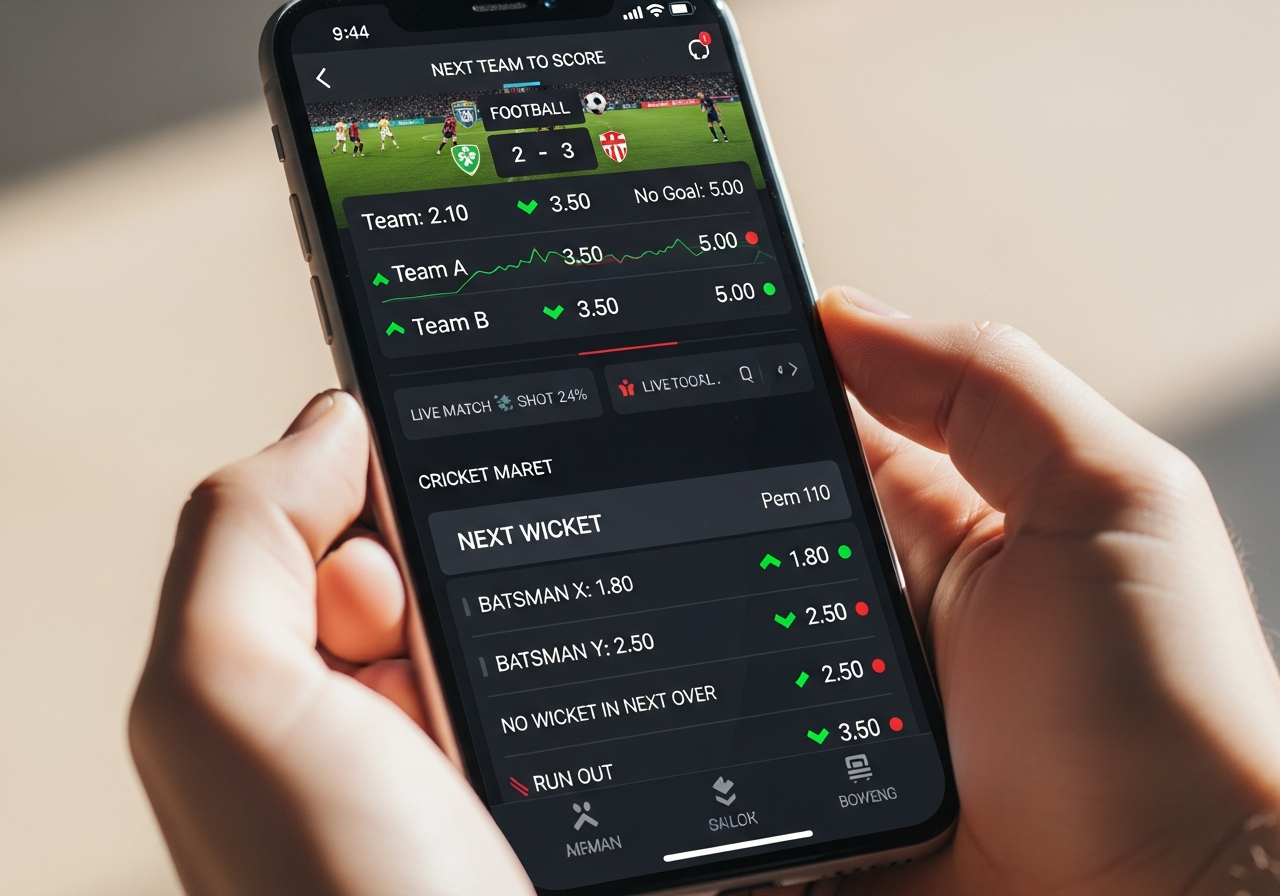
Live betting has transformed how Indian sports fans engage with football and cricket, opening up opportunities to place wagers during the action itself. Among the fastest-growing segments of in-play betting are next goal and next wicket markets—specialized, event-driven bets that reward quick decisions and live match awareness. These markets appeal to bettors who want to trade on immediate developments like a team’s current momentum, a pitcher’s form, or tactical shifts mid-match.
This guide isolates next goal and next wicket markets as dedicated topics, exploring how Indian betting sites structure and price these bets, what strategies work in practice, and how to manage the psychological and financial risks of high-volatility in-play wagering. Whether you’re tracking live football leagues or IPL cricket, you’ll find practical frameworks for spotting value, using live data effectively, and integrating next goal bets into a broader live betting strategy.
What Are Live Next Goal Markets on Indian Betting Sites?
Live or in-play betting refers to wagers placed after a match has started, with odds updating in real time as events unfold. Next goal markets are a subset of fast, event-driven bets where the outcome depends on a single impending event—a goal, wicket, boundary, or specific player action. Unlike match-result markets that settle at full-time, next goal and next wicket bets settle within seconds of the event occurring, making them ideal for traders and momentum-driven bettors.
On Indian betting sites, next goal style markets span two main sports. In football, bettors can back the next team to score, the first or next goalscorer by name, the time range of the next goal, and related props like both teams to score in the next 10 minutes. In cricket, particularly during IPL live markets, equivalents include the next man out (next wicket), the method of the next dismissal, whether a boundary is hit in the next over, and current innings run projections. Both sports see rapid odds movement as match state, tactical deployments, and individual form shift within minutes.
Difference Between Pre-Match and Live Next Goal Betting
Pre-match next goal markets are fixed at the start of the match and move only with general odds market shifts. Live next goal bets, by contrast, adjust dynamically based on immediate match conditions. If a team is leading 2–0 with 20 minutes left, odds for that team to score next remain short; if they fall 2–0 behind, odds lengthen sharply and the opponent’s odds compress. Similarly, in cricket, odds for the next wicket shift based on current run rate, bowlers in operation, and batsman partnerships.
The volatility in live markets is higher because bettors and bookmakers react to real developments. A player substitution, a red card, or a change in bowling attack can swing next goal odds by 20–30% in seconds. Pre-match bets are typically lower-variance because they reflect only consensus expectations. This dynamism creates both opportunity and risk: value can emerge quickly, but confirmation delays and price slippage are common.
Event-Driven Live Markets: Goals, Wickets and Boundaries
Event-driven markets settle on a discrete, observable outcome rather than accumulated statistics. A next team to score bet is resolved the instant that team scores; a next player to be dismissed bet settles when the bowler clean-bowls or the batter is caught. This immediacy means odds can be mispriced briefly before bookmakers adjust, and bettors who act on real-time information gain an edge.
On Indian sites, next team to score typically pays out if either offensive team scores, with odds weighted by possession, formation and recent chance quality. Next player to score bets isolate individual forwards or aggressive midfielders, useful when one player dominates attacking play. In cricket, next man out bets reference the current batting lineup; method of next dismissal (caught, bowled, lbw, run-out) adds specificity and often better odds than simple next wicket. Next boundary in the next over locks in a one-over window, capturing the ebb and flow of death bowling or power-play aggression.
Types of Next Goal and Wicket Markets Available to Indian Bettors
Indian betting sites offer a range of next goal and wicket markets, each with different payout structures and settlement speeds. The core markets are widely available; niche variants depend on the bookmaker’s live trading depth.
- Next Team to Score (Football): Odds on either team scoring the next goal, regardless of who else scores in between. Typically reflects team momentum and current attacking setup.
- First/Next/Last Goalscorer (Football): Back a specific player to score the next goal in the match or within a half/period. First goalscorer bets are framed at kickoff; next goalscorer and last goalscorer are in-play updates. Odds shorten for forwards in form and lengthen for defenders.
- Next Wicket (Cricket): Wager on which batsman in the current lineup will be dismissed next. Odds adjust based on who’s batting, bowler matchups, and pitch conditions. Highly volatile during power-plays and death overs.
- Time of Next Goal (Football): Bet on the minute range (e.g., 40–45 minutes) in which the next goal is scored. Rare but offered by some Indian sites; useful for anticipating tactical shifts late in halves.
- Both Teams to Score in Next X Minutes (Football): A live market where both teams must score within a defined window (e.g., 5–10 minutes). Common in open, attacking matches.
- Method of Next Dismissal (Cricket): Specify how the next batter is dismissed—caught, bowled, lbw, run-out, or stumped. Offers richer odds than plain next wicket because it requires reading the bowler’s intent and field placement.
- Current Innings Runs (Cricket): Over/under bets on total runs in the current IPL innings, updated live. Popular as a complementary bet alongside next wicket and next boundary.
Advanced Variants: Player Props and Combo Markets
- Player Shots on Target (Football): In-play market tracking a specific player’s shot accuracy or total shots in the next 10 minutes. Less common but offered by premium sportsbooks covering major leagues.
- Same-Game Multiplier Combos (Cricket & Football): Combine next goal/wicket with match result or total goals/runs. For example, “Next goal by Team A AND match draw at 3.5:1.” Multipliers amplify odds but require all legs to win; useful for bankroll stretching if disciplined.
- Bowler-Specific Wicket Markets (Cricket): Wager on a particular bowler taking the next wicket, or a specific batsman being dismissed by a specific bowler. Available during IPL live sessions on specialist sites like Betwinner and Parimatch.
- Player Runs or Points Next (Cricket & Football): In some niche offerings, bettors can back a player to accumulate a specific number of runs (cricket) or shots/passes (football) in the next over/period.
Best Indian Betting Sites for Live Next Goal Markets
Indian betting sites vary widely in their live next goal and wicket market depth, live streaming capabilities, and user interface responsiveness. The table below compares leading platforms on these criteria.
| Brand | Best For | Key Live Markets | Live Features | Typical Sports Focus |
|---|---|---|---|---|
| Parimatch | Balanced Football & Cricket | Next goal, next team to score, next wicket, method of dismissal, current innings runs | Live streaming, cash out, live stats, mobile-first | Football (all major leagues) + IPL, domestic cricket |
| 1xBet | Depth of Football Markets | First/next/last goalscorer, both teams to score, next goal time windows, next corner | Extensive live statistics, real-time odds, bet editor | European football, Asian handicap specialists |
| Dafabet | Asian Markets Focus | Next goal, next team, next wicket, next boundary, live accumulators | Clean interface, responsive live section, live chat | Premier League, La Liga, IPL, kabaddi |
| 22Bet | Speed & User Experience | Next team to score, next goalscorer, next wicket, method of dismissal | Fast odds updates, intuitive live betting hub, notifications | Football (all leagues) + cricket (IPL focus) |
| Rajabets | IPL Specialists | Next wicket, method of dismissal, current innings runs, next boundary, wicket in next over | Live streaming of IPL, detailed match stats, quick settlement | Domestic Indian cricket, some football |
| Betwinner | Niche Player Props | Bowler-specific wicket bets, batsman dismissal method, combined next goal/wicket multipliers | Advanced bet builder, live animations | Cricket (all formats) + European football |
| 10Cric | Mobile-First Live Betting | Next team to score, next goal, next wicket, current runs | App-optimized live section, push notifications, low latency | IPL focus, international cricket, some football |
Next goal and wicket markets are most liquid during major events: Premier League and Champions League matches for football, and IPL games during the season. During off-season or lower-tier matches, market depth shrinks and odds may lag slightly.
Football-Focused Indian Sites with Strong Next Goal Coverage
Parimatch, 1xBet, and 22Bet are recognised leaders in live football next goal markets across Indian football betting. These sites typically offer next team to score, first/next/last goalscorer, time-windowed next goal bets, both teams to score in X minutes, and over/under next goal lines. 1xBet and 22Bet excel in European league coverage (Premier League, La Liga, Serie A, Bundesliga) with odds that frequently undercut rivals on goalscorer props. 10Cric and Dafabet provide competent football next goal coverage but place greater emphasis on IPL and Indian domestic cricket.
Live streaming is standard on all platforms for major matches, but responsiveness varies. Parimatch and Dafabet load live statistics fastest; 1xBet’s odds tables update smoothly but sometimes lag by 1–2 seconds during peak action. The cash-out feature is universal, allowing bettors to lock profits or limit losses on live next goal positions before the event occurs.
IPL and Cricket Specialists for Next Wicket and Boundary Markets
For IPL live markets, Parimatch, Betwinner, Rajabets, and 10Cric lead in next wicket depth, method of dismissal granularity, and current innings run bets. Rajabets offers dedicated IPL live streaming with integrated market tables showing next wicket odds by batsman, next boundary odds, and powerplay/middle-over/death-over phase transitions. Betwinner stands out for niche markets like “bowler X takes next wicket” and combined multipliers (e.g., “next wicket is a caught dismissal AND Team A wins the match”).
These sites also feature real-time, match-by-match updates of runs, wickets, and overs. During IPL seasons, live markets refresh every 3–5 seconds. Settlement speed is typically 5–10 seconds post-event, which is important for bettors who want to immediately place follow-up next wicket or next boundary bets. Current innings run markets (over/under) are commonly paired with next wicket bets as complementary hedges.
How Live Next Goal Odds Move During a Match
Live next goal odds respond to multiple factors in real time, creating a dynamic pricing environment. Understanding how odds shift helps bettors identify value and time their bets strategically.
Time decay is a primary driver. As the match progresses, the probability of any future goal changes simply because fewer minutes remain. In football, a next goal bet is typically offered until a goal is scored; each minute without a goal slightly increases the odds of an imminent goal (if both teams are attacking) or decreases odds (if one team is dominant and the other defensive). Bookmakers adjust margins as time shrinks, reflective of reduced outcome variance.
Scoreline and tactical adjustments shift odds dramatically. If the leading team is protecting a narrow lead late in the match, next goal odds on the trailing team compress, reflecting increased attacking intent and defensive vulnerability. A red card (10 vs 11 players) can swing next goal odds by 40–50% instantly. In cricket, a wicket collapse triggers rapid re-pricing of next wicket odds; losing two quick wickets shortens odds for the next dismissal as incoming batsmen face fresh bowlers.
Run rate and pitch conditions are cricket-specific drivers. In an IPL over, if the current run rate is 9 per over and target is 160, next boundary odds shorten because aggressive batting is necessary. Conversely, if a team is ahead on par-score, boundary odds lengthen as bettors expect caution. Pitch deterioration late in an innings increases next wicket odds as variable bounce aids bowlers.
Implied probability is the bookmaker’s assessment of outcome likelihood, extracted from odds. A next goal bet quoted at 2.0 implies a 50% probability; 3.0 implies 33%. Bookmakers protect margins (typically 2–5% on fast markets) by adjusting these probabilities as new information arrives. Bettors who monitor live odds across multiple sites can identify value when one bookmaker lags in repricing.
Key Factors Influencing Next Goal and Wicket Prices
- Team Possession and Attacking Shape: Teams with the ball and an open formation face shorter next goal odds. Defensive shapes and set-piece focus lengthen odds.
- Player Form and Substitutions: A striker entering the pitch after sitting on the bench shortens goalscorer odds for that player; withdrawal of a key defender lengthens opponent next goal odds.
- Current Run Rate (Cricket): In IPL, a run rate of 10+ per over increases next boundary odds; rates below 5 per over decrease them, as batsmen are expected to work singles and avoid risks.
- Wickets Lost and Partnerships (Cricket): A batting collapse (3+ wickets in 5 overs) shortens next wicket odds; a stable partnership lengthens them.
- Remaining Overs and Time: In both sports, reduced time/overs remaining increases volatility. A 10-minute window in football sees faster odds swings than a 30-minute window.
- Pitch Conditions and Weather: Deteriorating pitches favour bowlers (shorter next wicket odds); wet conditions slow play, extending time windows and softening odds.
- Red Cards, Injuries and Tactical Shifts: Any mid-match tactical change (formation switch, conservative setup) triggers repricing across all event markets.
Using Live Data, Streaming and Tools to Bet on Next Goal Markets
Indian betting sites provide integrated live data feeds, streaming, and analytical tools to support in-play next goal and wicket decisions. Leveraging these effectively increases the speed and accuracy of your bets.
- Live Streaming Integration: Most top Indian sites (Parimatch, 1xBet, Dafabet, 22Bet) embed live video feeds directly into the sportsbook. This allows bettors to watch play and cross-reference with live odds on the same screen, eliminating delays from external streaming sources.
- Heat Maps and Shot Maps (Football): Advanced sites display real-time heat maps showing which areas of the pitch are generating the most activity, and shot maps pinpointing where shots on target originate. These visual cues help assess imminent goal probability better than raw statistics.
- Live Statistics Panels: Current pass completion, shots on target, possession percentage, and expected goals (xG) are refreshed in real time. Indian sites increasingly offer xG metrics to gauge underlying shot quality, informing next goal odds accuracy.
- Odds Comparison Across Sites: Third-party services like Odds.net or individual bookmaker monitoring allow bettors to spot discrepancies. If Parimatch quotes a next goalscorer at 4.0 while 1xBet quotes 3.5, value exists on the longer odds.
- Live Updates and Notifications: Push notifications alert bettors to goals, wickets, and key match events. Combined with mobile apps, these enable rapid-response betting when odds are fresh.
Cash Out and Bet Edit Features in Fast Live Markets
Cash out allows bettors to settle a live next goal bet before the event occurs, locking in profit or loss. If you back the next team to score at 2.0 and the team is now dominant with 10 minutes left, the bookmaker may offer a cash-out value of 1.8 (reflecting heightened win probability). This is useful for securing gains without waiting for the event, or for cutting losses if momentum shifts unexpectedly.
Bet edit (offered by Parimatch, 1xBet and others) lets bettors modify stakes or add legs to a live bet without voiding the original. If a next goal bet looks strong but under-staked, bet edit enables a top-up without placing a new, separate wager. This is particularly valuable during IPL when a next wicket bet can be amended mid-over if the bowler changes.
Mobile App Experience for In-Play Goal and Wicket Bets
Indian betting apps optimized for live markets prioritize speed, clarity, and responsiveness. Key features include:
- Low-Latency Odds Display: Odds refresh every 1–2 seconds, ensuring you see real-time pricing before placing a bet. Parimatch and Dafabet apps excel here.
- Streamlined Bet Slip: One-tap bet placement, stake entry, and instant confirmation. Avoid apps with multi-page bet flows that slow down rapid betting.
- Live Event Feeds: Integrated score tickers, commentary summaries, and event timelines (goal at 34′, red card at 67′) appear prominently so you’re never out of sync.
- Push Notifications for Key Events: Goal, wicket, red card, and major stat alerts. These help bettors who step away from the screen catch critical market shifts.
- Responsive Charts and Graphs: Some premium apps (Betwinner, 1xBet) offer live odds graphs showing how next goal or next wicket prices have moved over the last 5 or 10 minutes, helping spot trends.
- Quick Cashout Button: A dedicated cash-out section showing available offers, updated in real time, without requiring navigation through menus.
Step-by-Step: Placing a Live Next Goal Bet on Indian Sites
Placing a next goal bet involves several stages. Follow this flow to minimize errors and lag.
- Create Account and Complete KYC: Register with your chosen site (Parimatch, 1xBet, Dafabet, etc.), verify email and phone, and complete Know Your Customer (KYC) identity checks. This typically requires a government-issued ID and proof of address. KYC must be cleared before live betting is enabled.
- Deposit Funds: Transfer money via UPI, bank transfer, or e-wallet (Paytm, PhonePe, Google Pay are standard in India). Minimum deposits are typically ₹100–₹500; maximum limits depend on the site.
- Access the Live Betting Section: Navigate to “Live Betting,” “In-Play,” or a similar live markets hub. Browse by sport (football, cricket) or search for a specific match.
- Select the Match and Market: Click the live match (e.g., Liverpool vs Manchester City), then choose the next goal market (next team to score, next goalscorer, next wicket for cricket, etc.).
- Enter Your Stake: Click the odds for your selection, enter your stake in the bet slip, and review implied odds. Note that odds may change; the bet slip will warn you if repricing occurs before confirmation.
- Confirm the Bet: Click “Place Bet” and wait for confirmation. A betting notification should appear within 2–3 seconds. Avoid multiple clicks, which can result in duplicate bets.
- Monitor Market Availability: Note that certain markets may be suspended temporarily if an imminent event (goal, wicket) is occurring. If your market disappears briefly, wait 10–15 seconds for it to reopen.
Common Errors to Avoid in Fast In-Play Betting
- Chasing Losses: After a losing next goal bet, resist the urge to immediately place a larger bet on the same market to recover. This violates bankroll discipline and leads to tilt.
- Ignoring Bet Confirmation Warnings: If the bet slip shows “Odds have changed,” review the new odds before confirming. Stale odds displayed before repricing can lead to unfavourable fills.
- Over-Staking High-Variance Markets: Next goal and wicket bets are volatile. Stake 1–2% of your bankroll per bet, not 5–10%.
- Betting Without Understanding Settlement Rules: Clarify whether a next goal market is per team, per player, or per match phase before placing money. Ambiguity causes disputes.
- Placing Bets During Lag or Slow Connections: Bet placement during network delays risks duplicate bets or missed confirmation. Use stable WiFi for mobile betting.
Strategy Fundamentals for Next Goal Markets in Football
Next goal betting rewards understanding match dynamics, attacking patterns, and odds behaviour. Unlike pre-match result markets, next goal strategies focus on moment-to-moment shifts.
Game state analysis is foundational. A team leading 2–0 with 20 minutes left is less likely to score next because they’re defending. The trailing team, desperate to reduce the deficit, typically increases attacking pressure, shortening their next goal odds. Conversely, if a match is level late in the second half, both teams are aggressive, and next goal odds on both sides converge. Recognizing these states helps identify when odds overestimate or underestimate a team’s attacking intent.
Expected goals (xG) is a metric tracking shot quality, indicating underlying scoring probability. If a team has accumulated 0.8 xG in 30 minutes while the opponent has 0.2 xG, the first team’s next goal odds should be shorter. However, bookmakers may lag in repricing; if a team’s xG suddenly rises (e.g., a key attacker enters), next goal odds for that team are briefly undervalued. Bettors who track live xG updates can exploit these windows.
Substitution patterns reveal tactical intent. When a team trailing 1–0 substitutes on a striker in the 60th minute, their next goal odds shorten; the removed player’s odds vanish. Anticipating likely substitutions (based on match situation and typical manager behaviour) allows you to bet on a goalscorer before that player enters, capturing better odds.
Late-game scenarios (final 10–15 minutes) are rife with volatility. A goal-down team often commits defenders forward, creating space for counterattacks. Odds on trailing teams shorten, but so do odds on the leading team to score on the break. Identifying which team’s attacking shape is more dangerous informs higher-edge bets.
Exploiting Tempo Changes and Tactical Shifts
- High-Pressing Triggers: When a trailing team switches to high press (compact defending deep in the opponent’s half), they sacrifice positional organization. Watch for next goal odds on the pressing team tightening as attackers are moved forward; if those odds are stale, backing them offers value.
- Tired Defences: Around the 70–75 minute mark, defensive organization often deteriorates as fatigue sets in. Backs are slower to react; next goal odds on attackers sharpen. Intelligent bettors back next goalscorer bets on fresh substitutes or players known for late-match impact.
- Formation Changes: A switch from 4–2–3–1 to 3–5–2 (adding an attacker) signals increased attacking intent. Live odds on that team’s next goal should shorten; if they don’t immediately, a value gap exists.
- Set-Piece Opportunities: Late-game free kicks or corners increase next goal probability, sometimes beyond what odds suggest. If a team has earned multiple dangerous set-pieces within 5 minutes, backing their next goal at current odds can be profitable.
Integrating Next Goal Bets with Other Live Football Markets
Rather than betting next goal in isolation, combine it with complementary markets to build coherent in-play strategies. If you believe Team A will score next and a draw is still the most likely result, back Team A next goal + draw (a bet combination available on many Indian sites) at higher odds than next goal alone. Alternatively, if Team B looks dangerous on the counter, back Team B next goal + Team A to win the match, capturing both the imminent goal and the overall match expectation.
Over/under next goal lines (e.g., under 1.5 goals in the next 10 minutes) can be paired with next goal team bets. Backing Team A to score next while also backing under 1.5 goals in 15 minutes hedges the risk if the match tightens defensively. Asian handicap live markets (e.g., -0.5 goals, -1 goal) offer alternative angles when next goal markets lack value.
Strategy Fundamentals for Next Wicket and Boundary Markets in Cricket
Cricket next wicket and boundary markets hinge on bowler–batsman matchups, run rate, and phase-of-play dynamics. Strategic success requires reading the IPL live environment accurately.
Run rate is the primary driver. In an IPL chase needing 160 from 20 overs, a run rate of 8 per over is sustainable; above 10 per over and the batting team becomes aggressive, increasing boundary frequency and decreasing next wicket odds (fewer balls faced per wicket). Bettors tracking the required run rate and comparing it to current rate can anticipate when batsmen will attack or consolidate.
Required runs and wickets in hand shift odds inversely. If a team requires 60 runs from 36 balls with 5 wickets in hand, they’re in a comfortable position; next wicket odds are longer because batsmen have the luxury of caution. If the same team needs 60 from 36 but only 2 wickets remain, next wicket odds shorten as pressure increases and risky shots become inevitable.
Pitcher/bowler matchups are critical. A left-arm spinner bowling to a right-handed batter unfamiliar with the angle creates higher dismissal likelihood; conversely, a batter with a strong track record against a specific bowler sees next wicket odds lengthen. IPL broadcasters often provide historical matchup data in live coverage, which bettors can leverage immediately.
Pitch deterioration late in an innings (ball scuffing, irregular bounce) aids bowlers. A pitch that was batting-friendly in overs 1–10 turns hostile by overs 15–20, raising next wicket odds for the batting team. Bettors attentive to commentary about pitch behaviour gain an edge.
Reading Game Phases: Powerplay, Middle Overs and Death Overs
- Powerplay (Overs 1–6): Limited fielder restrictions near the boundary incentivize aggressive batting. Boundary odds are short; next wicket odds are long because batsmen prioritize scoring over caution. However, bowlers often deploy tight lines to contain; unexpected wickets in the powerplay pay generous odds.
- Middle Overs (Overs 7–15): Standard fielding rules apply. Run rate normalizes; next wicket and next boundary odds settle into balanced territory. This is the phase where individual batter skill and bowler experience matter most. Use pitch and matchup data heavily here.
- Death Overs (Overs 16–20): Aggressive batting targets sixes; boundary odds shorten sharply. Bowlers rely on yorkers and slower balls; next wicket odds shorten as batsmen play risky shots. The final over often sees extreme odds swings based on required runs and available batsmen.
Risk Management for High-Variance Next Goal Markets
Next goal and next wicket bets are inherently volatile because a single event (goal, wicket, boundary) determines the outcome, and events are relatively rare compared to total match time. Proper risk management is essential to avoid ruin.
These bets should constitute no more than 5–10% of your overall betting turnover. If your monthly betting volume is ₹50,000, allocate ₹2,500–₹5,000 to next goal and wicket props. The remaining 90–95% should cover lower-variance markets like over/under goals, double chance, and current innings runs.
Unit sizing prevents excessive loss on a single slip. A unit might be ₹100 or ₹500 depending on your bankroll; never stake more than 2–3 units on a single next goal bet. If a bet loses, accept the loss and move on; avoid doubling down immediately on the next market.
Pre-defined session budgets restrict daily losses. If you set a ₹2,000 daily limit for in-play bets and lose ₹2,000 by mid-afternoon, stop betting and resume the following day. Chasing losses invariably leads to tilt and larger losses.
Stop-loss rules prevent emotional decision-making. If a next goal bet is losing (the team you backed is being outshot and time is running out), cash out at 0.3–0.4 (30–40% of stake) and accept the loss rather than hoping for a miraculous late goal.
Bankroll Allocation Between Pre-Match and Live Bets
A balanced strategy splits your bankroll between pre-match research and live trades. If you have ₹100,000, allocate ₹60,000 to pre-match bets (researched overnight, placed before kickoff) and ₹40,000 to live bets (in-play, reactive). This ensures that losses on volatile next goal bets don’t deplete your entire bankroll, and that pre-match positions provide steady returns to offset in-play variance.
Multiple in-play bets on the same match are correlated—both next goal and next boundary bets on an IPL innings share common drivers (bowler changes, pitch conditions). When placing two or more related in-play bets, treat their combined stake as a single exposure; don’t stake as if they were independent.
Psychological Traps in Fast Live Markets
- Tilt (Emotional Escalation): After losing a next goal bet, frustration tempts larger bets on the next market to recover losses quickly. Resist this. Take a 5-minute break after a loss before placing the next bet.
- FOMO (Fear of Missing Out): Seeing another bettor’s winning next goal post on social media triggers urgency to bet immediately on the next match. FOMO overrides research and leads to poor bet selection. Pause and reassess before acting.
- Overconfidence After Wins: A successful next goal bet builds false confidence, leading to over-staking on the next market. Winning streaks are often random; maintain unit sizing regardless of recent results.
- Over-Reacting to Single Events: One wicket doesn’t confirm a collapse; one goal doesn’t confirm a team’s dominance. Avoid placing bets immediately after a single event; wait 2–3 minutes for odds to stabilize and assess if the event genuinely signals a strategic shift.
- Recency Bias: A team’s recent goal-scoring form shouldn’t override current match state. If a high-scoring team is trailing and defensive, their next goal odds are justified longer than historical scoring rates suggest.
Legal, Regulatory and KYC Aspects for Indian Live Bettors
Sports betting in India operates in a complex regulatory landscape. Most Indian states do not explicitly permit sports betting, but do not explicitly prohibit it either. Offshore-licensed sites (Parimatch, 1xBet, Dafabet, etc.) serve Indian bettors from jurisdictions like Curaçao or Malta, relying on the absence of explicit blocking rather than affirmative permission. This arrangement is legal for end-users (bettors) but unregulated locally.
Using reputable, internationally licensed bookmakers is essential. These sites are audited by third-party bodies, honor payouts, and maintain responsible gambling standards. Avoid unverified or unlicensed sites offering promotions that seem too generous; these are often scams or money-laundering fronts.
KYC (Know Your Customer) requirements are mandatory on licensed sites. You must provide government-issued ID (passport, driving license, Aadhaar), proof of address (utility bill, rental agreement), and sometimes a selfie. This process takes 24–48 hours. KYC protects both you (via regulated dispute resolution) and the bookmaker (via anti-fraud and anti-money-laundering compliance).
Payment methods available to Indian users include UPI (Google Pay, PhonePe, Paytm), bank transfer, and e-wallets. Withdrawals typically process within 24–72 hours. Keep records of deposits and withdrawals for personal tax and audit purposes.
Responsible Gambling Tools for In-Play Sessions
- Deposit Limits: Set a daily, weekly, or monthly cap on how much you can deposit. Once reached, further deposits are blocked until the period resets.
- Loss Limits: Define maximum losses for a session or day. If losses hit the limit, all betting is suspended for the remainder of the period.
- Time-Outs: Request a temporary suspension (24 hours to 30 days) if you feel betting is becoming problematic. Your account is frozen; you can resume after the time-out expires.
- Reality Checks: Notifications at regular intervals (every 30 or 60 minutes) remind you of your total bets, wins, and losses. These interruptions help counter tilt.
- Gambling Self-Exclusion Programs: In India, while national self-exclusion databases are limited, many international sites allow you to self-exclude from their platform permanently.
- Link to Helplines: Reputable sites provide contact information for gambling addiction support organizations (e.g., National Council for Mental Health in India).
Comparing Live Next Goal Markets to Broader Prediction Markets
| Aspect | Sports Next Goal Markets | Financial/Political Prediction Markets |
|---|---|---|
| Time Horizon | Minutes to hours (single match event) | Days to months (election, economic release) |
| Regulation in India | Offshore-licensed bookmakers (unregulated locally) | Mostly inaccessible; offshore prediction markets lack India-specific regulation |
| Information Sources | Live match data, player stats, real-time commentary | News feeds, economic data, polling, political analysis |
| Liquidity | High during major events (IPL, Premier League); low otherwise | Variable; political markets spike near election dates |
| Settlement Speed | Seconds to minutes (goal, wicket) | Days (sports) to weeks (political events) |
| Odds as Signals | Real-time probability of imminent event | Aggregate forecast of uncertain future outcome |
| House Edge | 2–5% (fast markets); 3–7% (slower markets) | 2–5% (high-volume events); 5–10% (niche events) |
Live odds in sports next goal markets function as real-time probability signals, much like prediction markets in finance or politics. The odds incorporate collective information from millions of bettors, algorithms, and live data feeds, compressing that intelligence into a single decimal number. If next goalscorer odds on a player are 4.0 when that player has an xG of 0.6 per 90 minutes and is the primary attacker on the pitch, implied probability (25%) is likely underestimating true likelihood, suggesting value.
However, sports next goal markets are not perfectly efficient. Bookmakers apply a house edge (2–5% on major markets), and bettors collectively can be irrational, allowing skilled bettors to exploit mispricings. Prediction markets (e.g., PredictIt for US politics, or historical equivalent sports forecast markets) are more transparent about aggregate participant views, but sports betting markets are more liquid and accessible to Indian users.
Information Efficiency and Odds as Real-Time Signals
Live odds move rapidly as new information emerges (substitution, key pass, bowler change). An odds shift from 2.5 to 2.0 in 30 seconds likely reflects bookmaker repricing based on a live event or large bet inflow. Smart bettors use these shifts as signals of hidden information. If a next wicket market compresses suddenly despite no visible event, a key injury or field adjustment may have occurred off-camera, and the bookmaker is front-running the eventual announcement.
Conversely, odds can lag if a bookmaker is slow to process information. A slow-moving odds feed (updates every 5–10 seconds instead of every 1–2) may present stale odds, allowing you to exploit recent but unpriced developments. Comparing odds across multiple sites in real time reveals these gaps.
Site-by-Site Snapshot of Typical Live Next Goal Offerings
| Bookmaker | Football Next Goal Options | Cricket Next Wicket/Boundary Options | Live Interface Strengths | Notable Limitations |
|---|---|---|---|---|
| Parimatch | Next team, first/next/last goalscorer, both teams to score in X min, time ranges | Next wicket, method of dismissal, next boundary, current innings runs | Fast odds updates (1–2 sec), integrated streaming, intuitive live hub | Occasionally suspends niche markets during peak action |
| 1xBet | Next team, next player (multiple), next corner, next card, both teams in X min, detailed time windows | Next wicket, bowler-specific wicket bets, next dismissal method | Extensive match stats, real-time xG, detailed odds charts, live odds graph | Interface can feel cluttered; requires learning curve |
| Dafabet | Next team, next goalscorer, both teams to score, over/under next goal line | Next wicket, method of dismissal, next boundary, current runs | Clean, responsive design, strong live chat support, mobile optimization | Smaller niche market selection than 1xBet; less detailed player props |
| 22Bet | Next team, next goalscorer, both teams, time-window goals, next corner | Next wicket, method of dismissal, next boundary, wicket in next over | Fast odds refresh, push notifications for key events, straightforward layout | Slightly lower odds on some props vs Parimatch/1xBet; settlement can be slow during high volumes |
| Rajabets | Limited football next goal (mainly next team, next goalscorer); focus on cricket | Extensive next wicket, method of dismissal, current innings runs, next boundary, bowler-specific | Dedicated IPL streaming, detailed match-by-match stats, rapid settlement | Football markets shallow; live interface can be slow during peak IPL times |
| Betwinner | Next team, next goalscorer, both teams to score, advanced player props | Next wicket, method of dismissal, combined multipliers (wicket + match result) | Advanced bet builder, live odds animations, detailed statistical overlays | Smaller sports coverage; primarily focused on cricket and European football |
| 10Cric | Next team, next goalscorer (limited player depth), basic both teams to score | Next wicket, method of dismissal, current innings runs, next boundary | Mobile-app optimized, push notifications, low-latency odds, IPL focus | Limited desktop interface; football next goal markets lack depth vs Parimatch/1xBet |
Depth of Markets: From Core Bets to Niche Player Specials
Market depth varies by bookmaker. Core next goal markets (next team to score, next goalscorer by major players) are standard across all top sites. Niche markets differentiate leaders from followers: 1xBet offers next corner, next card, next throw-in, and player-specific props (e.g., “Player X to have a shot on target in next 10 min”). Betwinner combines next wicket with match result, creating “next wicket is caught dismissal AND Team A wins” multiplier bets at amplified odds.
Cricket markets similarly range from basic (next wicket, method of dismissal) to advanced (bowler-specific wickets, combined multipliers, powerplay phase-specific bets). Rajabets and Parimatch excel in depth; smaller sites like 10Cric focus on volume (ease of betting) over variety.
User Experience Factors: Speed, Layout and Market Discovery
- Clear Market Grouping: Top sites organize live markets by sport, then match, then market type (goals, corners, cards, wickets). Parimatch and Dafabet excel; 1xBet’s grouping is functional but less intuitive.
- Responsive Bet Slip: The bet slip (where you enter stake and confirm) should update odds in real time without lag. 22Bet and Parimatch are fastest; Dafabet is reliable but slightly slower.
- Market Search and Filtering: Use search to find a specific match or market (e.g., “next wicket IPL”) rather than browsing. Advanced filters (by league, odds range, market type) accelerate discovery on 1xBet.
- Favorites and Quick Links: Saving frequently bet-on markets as favorites saves browsing time. Most top sites support this; check if your chosen site does.
- Mobile App vs Web: Mobile apps typically load faster and offer better notification integration. Parimatch, 1xBet, and 22Bet have optimized apps; web versions are adequate but slower for in-play betting during major events.
Live next goal and next wicket markets represent a specialized, high-skill segment of in-play betting where knowledge of real-time match dynamics, odds behaviour, and risk management compound into consistent edges. By understanding how these markets structure, what drives odds movements, and how to integrate them with broader live betting strategies, Indian bettors can extract value while maintaining discipline and protecting their bankrolls against the inherent volatility of event-driven props.
The Indian betting landscape continues to mature, with leading sites like Parimatch, 1xBet, and Dafabet investing in live market depth, streaming, and user experience. As technology lowers latency and provides richer data feeds, opportunities for informed next goal and wicket bets expand. Success demands combining analytical rigour (reading xG, phase-of-play context, bowler matchups) with psychological resilience (avoiding tilt, respecting unit sizing, accepting variance). For bettors willing to invest in this foundation, live next goal markets offer both intellectual engagement and genuine profit potential.